A LUFS and tonal analysis of the top-charting holiday songs in 2025
Explore holiday music loudness through LUFS analysis, vintage vs. modern mastering, and insights into mastering for streaming LUFS from 1957 to today.
It’s been a few months since we’ve done a loudness analysis piece, but with the holiday season in full swing, we thought, “Why not do a little holiday music loudness analysis?” While it’s true that around our house I’m often given the moniker of “The Grinch” during the holidays – a title I’m not sure I fully deserve – this line-up has me particularly excited. Why? It gives us an opportunity to examine the sound of mixing and mastering across nearly six decades – from 1957 through 2014 – all while staying in one genre.
This allows us to organically compare vintage vs. modern mastering techniques and approaches, and potentially even answer the question, “Why do old Christmas songs sound so loud on streaming services?” – something it seems you have been asking about.
Curious? Read on. And if you're really into loudness analysis, I will be hosting a livestream on the Native Instruments Discord this Friday, December 19 at 11am EST.

What are we analyzing?
The music for this analysis came mostly from the Billboard Holiday 100 chart for the week of December 6th, 2025. I say “mostly” because, wouldn’t you believe it, there’s not a single Hanukkah song on that whole list. Having a Jewish mother, as well as maternal and paternal grandmothers, I had to include a little nod to my heritage. So, in addition to the top 10 from the Billboard chart, there’s a little bonus song for you at the end.
One interesting thing about the Holiday 100 chart is that it’s only updated five weeks out of the year – from about Thanksgiving to New Year's Day – and, as best I can tell, debuted on December 10th, 2011. A little trivia before we dig into it: in the 15 years since the chart debuted, only six songs have taken the number one spot, and two of them are currently in spots 37 (“Mistletoe” by Justin Bieber) and 63 (“Mary, Did You Know?” by Pentatonix), with one fallen off the chart entirely (“Little Drummer Boy” by Penatonix).
The other three remain in the top five, with the number one spot being held by – you guessed it – Mariah Carey, for 67 of the chart’s 75-week history.
Holiday music loudness analysis process
There are a few common questions people have when they read one of my analysis articles, so let’s cover those up front.
What sources were used for analysis?
For each of these songs, I purchased and downloaded the lossless, high-resolution file from the Qobuz store when available. This ensures that no streaming codecs or other hiccups get in the way. In a few, rare instances when a title isn’t available on the Qobuz store, I will stream the lossless version from Apple, at the native sample rate, with loudness normalization turned off.
Do the numbers include any normalization?
No. All analysis is done at the full, mastered level. That said, music discovery trends tell us that something like 85% of casual listeners listen with normalization turned on. So, just because something is mastered “loud” doesn’t mean that’s how people will experience it next to something “less loud.”
In fact, in a predominantly loudness-normalized playback world, I would argue that raw LUFS measurements tell us more about density than they do “loudness” – but that’s an article for another time. This is an important distinction when talking about mastering for streaming LUFS, because a master optimized purely for raw loudness will often behave differently once platform normalization is applied.
What about Atmos? Don’t those need to be at -18 LUFSi (LUFS integrated)?
Yes, the loudest Atmos mix on an album needs to not exceed -18 LUFS integrated. In fact, in some cases where both Atmos and stereo mixes of a song exist, we have an unusual and interesting opportunity to compare more and less dynamic versions of a song. For this analysis, though, only stereo versions were used.
So, in short, this analysis uses downloaded lossless files with no normalization – or any other processing – applied, with very few exceptions where titles are streamed. In either case, they are as close to what the mastering engineer was listening to as we can get.
Follow along with

RX 11 Advanced
The music
If you’re feeling festive and would like to listen along to the songs as you read, here’s a playlist with all of them, in order. Let’s get into it.
1. “All I Want For Christmas Is You” by Mariah Carey
Producer(s): Mariah Carey, Walter Afanasieff
Mixing: Mick Guzauski
Mastering: Bob Ludwig
Release Year: 1994
Short-term LUFS and spectrum of “All I Want For Christmas Is You”
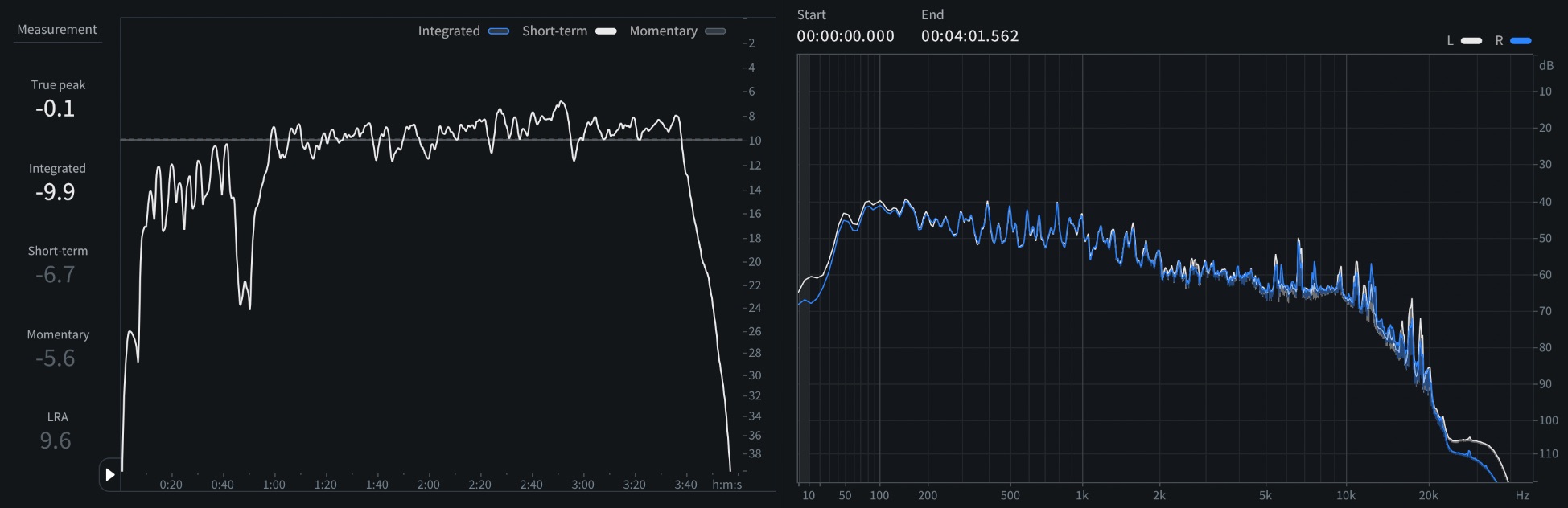
True Peak: -0.12 dBTP
Sample Peak: -0.25 dBFS
Int. Loudness: -9.9 LUFS
Loudness Range: 9.6 LU
Does fidelity equate to chart success? Not necessarily, but in this case, there’s certainly a correlation. If Mariah Carey’s mastering and mixing team of Bob Ludwig and Mick Guzauski looks familiar to you, they were responsible for Daft Punk’s GRAMMY-winning Random Access Memories. This song is a modern classic, and it’s hard to deny that it sounds great.
At -9.9 LUFS integrated, it’s loud but not too loud, leaving some room for the transients to breathe and hit. With a sparkly top end – thanks, sleigh bells! – and a big, wide soundstage, it’s a shining example of polished pop. If there’s anything sonically that dates this, it’s perhaps the low end, which starts to roll off a bit below about 80 Hz and doesn’t extend as low as we’ve become accustomed to. However, in a genre where songs released before 1965 still get as much airtime as those since then, that may not be a bad thing.
2. “Last Christmas” by Wham!
Producer(s): George Michael
Mixing: Chris Porter (?)
Mastering: Unlisted
Release Year: 1984
Short-term LUFS and spectrum of “Last Christmas”
True Peak: -0.13 dBTP
Sample Peak: -0.20 dBFS
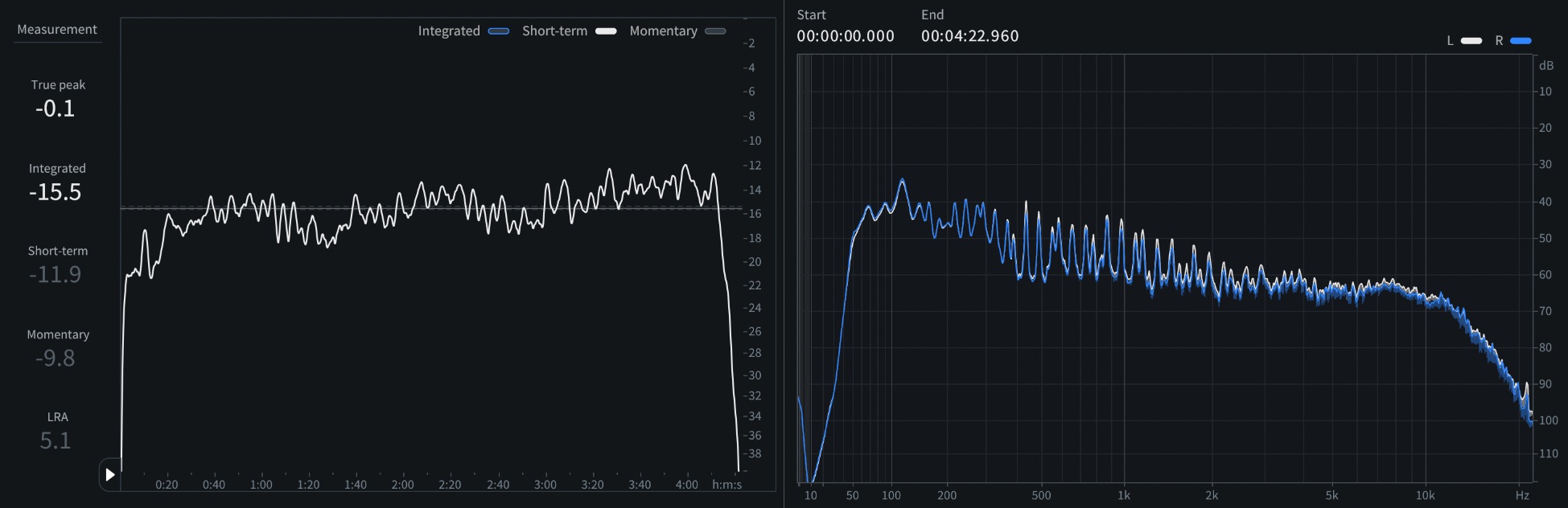
Int. Loudness: -15.5 LUFS
Loudness Range: 5.1 LU
While this is credited to “Wham!”, it’s pretty much a George Michael special with him writing, performing, and recording the whole song. If you’re after a polished, commercial 80s sound with no limiting, look no further. The integrated loudness of this one is on the low side – at least for pop – and yet even at -15.5 LUFS it continues to do just fine over 40 years later.
3. “Rockin' Around The Christmas Tree” by Brenda Lee
Producer(s): Owen Bradley
Mixing: Unlisted
Mastering: Unlisted
Release Year: 1964
Short-term LUFS and spectrum of “Rockin' Around The Christmas Tree”
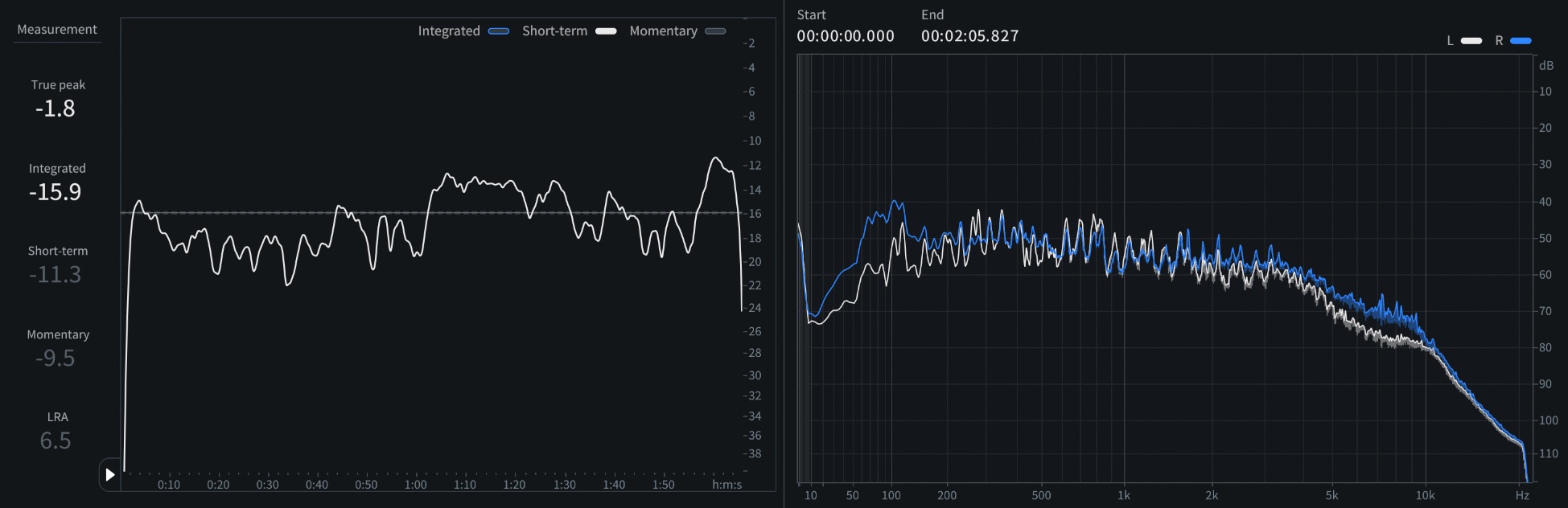
This is where things start to get interesting. Where do I even start? The background vocals are hard-panned left? The rest of the band – including drums – are hard-panned right? Brenda and the sax solo up the center? Ahh, the early days of stereo…
What about the level? It’s down at -15.9 LUFS with nearly 2 dB of peak headroom left, but is it just me or does it almost sound a touch louder than Mariah on streaming platforms, especially when that rippin’ sax solo comes in? This starts to get to the crux of what’s interesting about this analysis. Let’s keep listening and come back to why some of these old Christmas songs sound so loud on streaming.
4. “Jingle Bell Rock” by Bobby Helms
Producer(s): Paul Cohen
Mixing: Unlisted
Mastering: Unlisted
Release Year: 1957
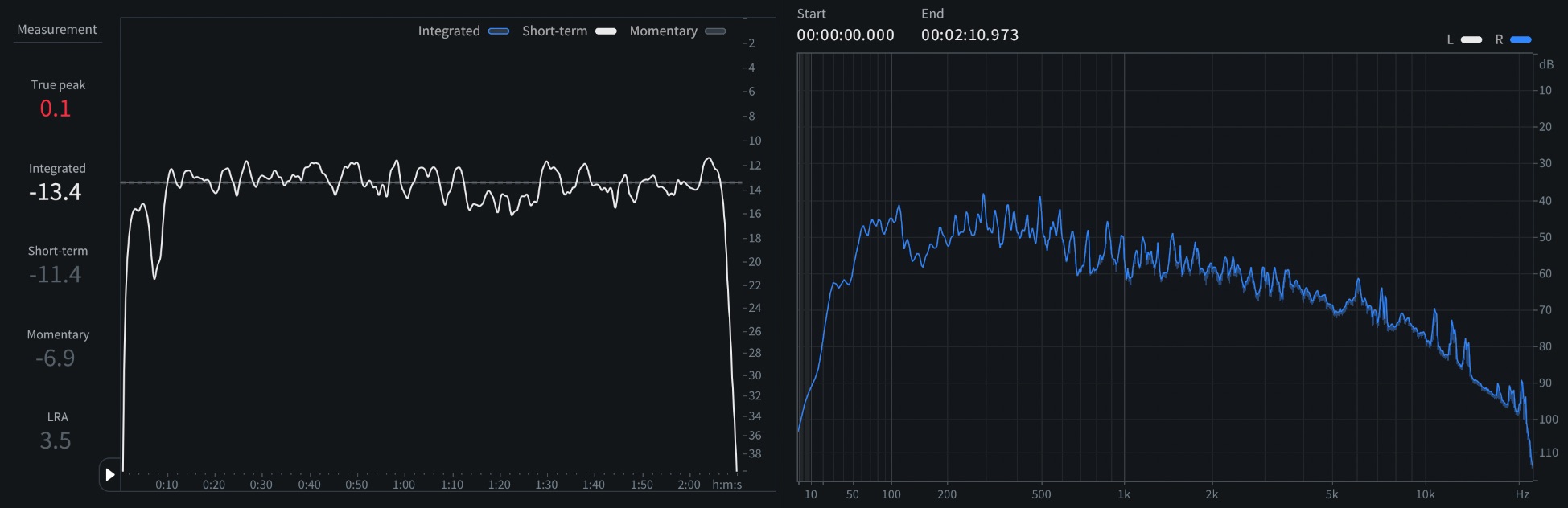
Short-term LUFS and spectrum of “Jingle Bell Rock”
True Peak: 0.15 dBTP
Sample Peak: 0.00 dBFS
Int. Loudness: -13.4 LUFS
Loudness Range: 3.5 LU
This next one takes us back in time another seven years, predating the stereo revolution, and we’re in glorious mono. First and foremost, let’s pause to appreciate the art of crafting a great mono mix. And frankly, not just the mix, but the arrangement and performance as well.
There’s so much we can learn from the guitar and vocal interaction alone. Notice how the guitar sits way back except for the little embellishments between vocal phrases? Timing when parts come in is one of the oldest – and best – ways to make sure the important elements keep focus.
And again, even at -13.4 LUFS, this tends to feel a bit louder than newer songs when played on streaming. What’s up with that? Again, we’ll come back to this.
Lastly, notice that little dropout at 0m 9.33s? That’s the kind of stuff we listen for in quality control – the very final step in mastering – these days, and when we find it, we can fix it with RX.
5. “Santa Tell Me” by Ariana Grande
Producer(s): Ilya Salmanzadeh, Max Martin
Mixing: Serban Ghenea, John Hanes
Mastering: Tom Coyne
Release Year: 2014
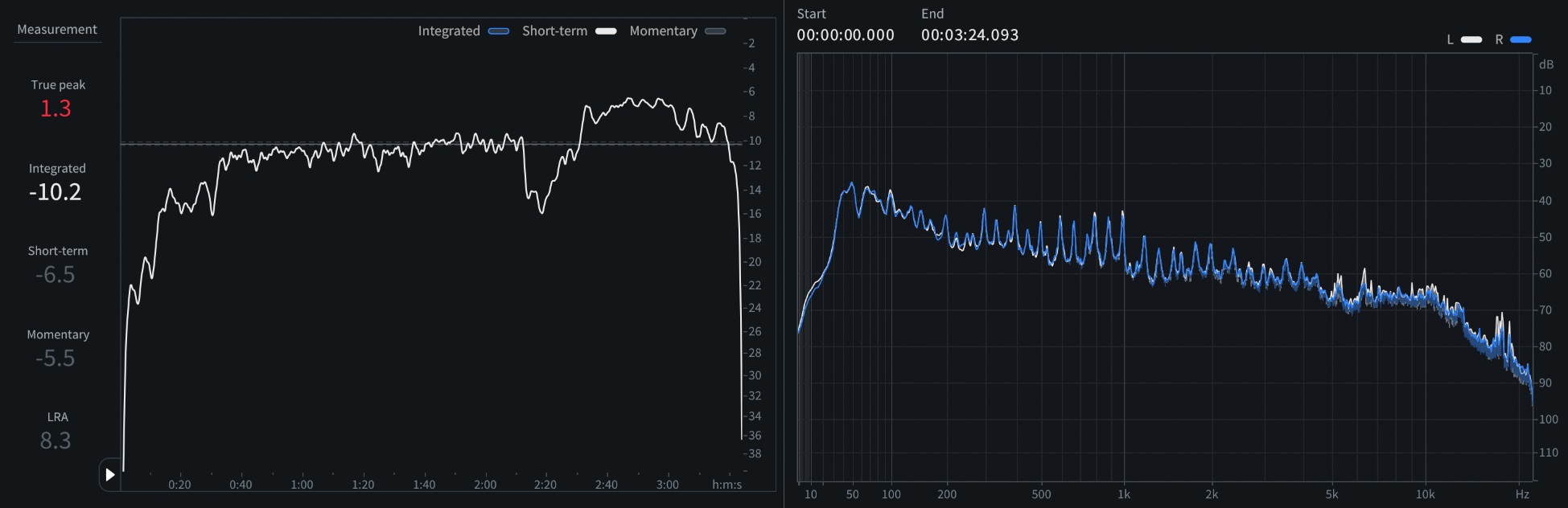
Short-term LUFS and spectrum of “Santa Tell Me”
True Peak: 1.30 dBTP
Sample Peak: -0.01 dBFS
Int. Loudness: -10.2 LUFS
Loudness Range: 8.3 LU
Fast-forward back to 2014, and we’ve got a more modern take on a Christmas anthem by absolute pop royalty. Just take a look at those credits. Earlier, I mentioned the low end rolloff in “All I Want For Christmas Is You” as a sign of its age. Compare that here to the extension of more than a full octave lower. That sub-bass extends down to 38 Hz.
Something interesting happens with the level here, too. We’re back up at more typical pop levels – although it has to be said that -10.2 LUFS is hardly screaming-loud for modern pop – and yet it sounds at least equally as loud as Brenda Lee’s “Rockin’ Around The Christmas Tree,” especially that final chorus. Curiouser and curiouser! More to come, but take a look at that short-term loudness trace above and see if you can spot the final chorus.
6. “It's The Most Wonderful Time Of The Year” by Andy Williams
Producer(s): Robert Mersey
Mixing: Unlisted
Mastering: Unlisted
Release Year: 1963
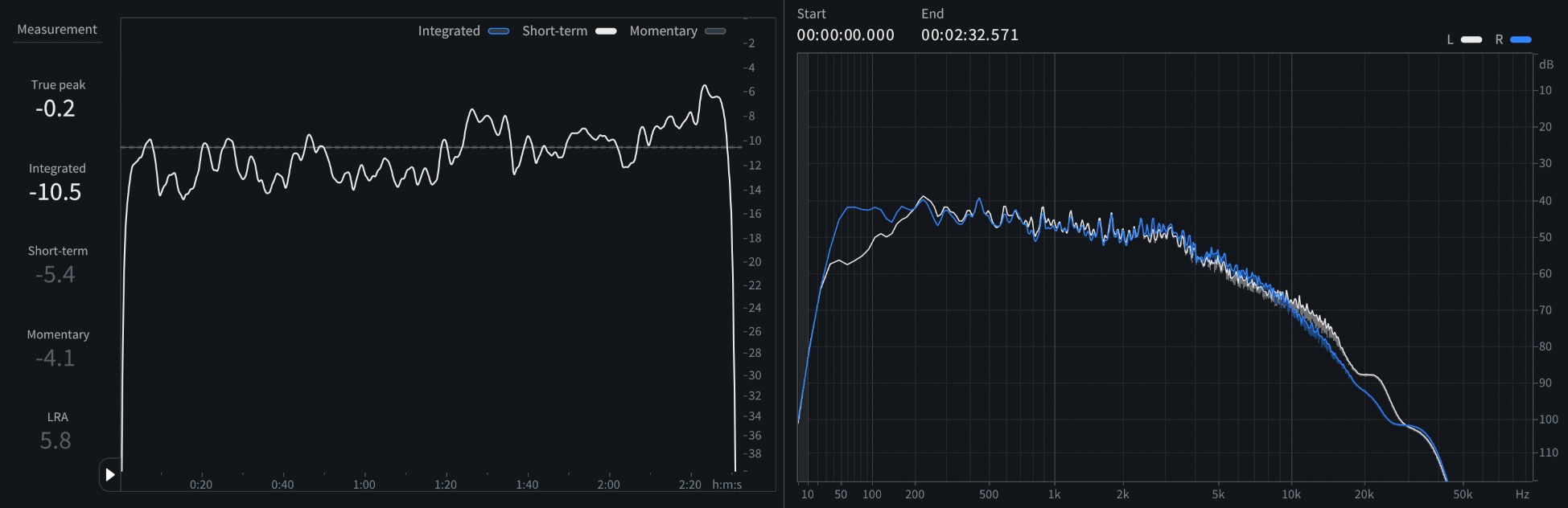
Short-term LUFS and spectrum of “It's The Most Wonderful Time Of The Year”
True Peak: -0.21 dBTP
Sample Peak: -0.23 dBFS
Int. Loudness: -10.5 LUFS
Loudness Range: 5.8 LU
For this one, we’re dashing back to 1963. It’s not entirely clear the extent to which it’s been remastered for digital release, and while there are no signs of brick-wall limiting, at -10.5 LUFS, I can’t help but suspect that a little compression was involved. Also, more opportunities for some RX clean-up in the beginning, anyone?
Whatever the case, it is a loud -10.5 LUFS, especially as it builds toward the end. Not to mention the fact that there is no limiting, and it doesn’t spend that much time near full scale. So seriously, what is going on? Do you have any theories as you listen and look at the loudness trace or frequency response? Start locking in your predictions.
7. “The Christmas Song (Merry Christmas To You)” by Nat "King" Cole
Producer(s): Lee Gillette
Mixing: Unlisted
Mastering: Bob Norberg (remastering)
Release Year: 1961, Remastered 1999
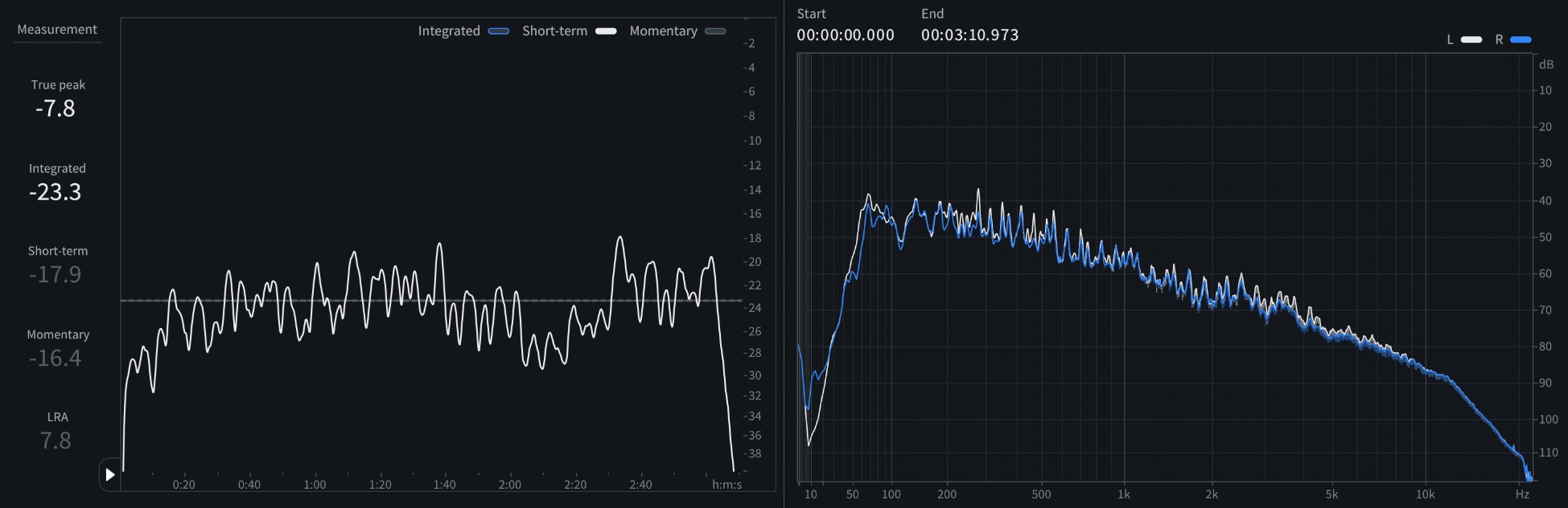
Short-term LUFS and spectrum of “The Christmas Song (Merry Christmas To You)”, original
True Peak: -7.80 dBTP
Sample Peak: -7.82 dBFS
Int. Loudness: -23.3 LUFS
Loudness Range: 7.8 LU
This next one gives us a unique opportunity we don’t often get on streaming. There are two versions available. The one above is what I suspect is a straight digital transfer of the original tape, while below we have the 1999 remaster.
Take a listen to both, and try jumping back and forth between them to similar spots in the song. Take note of what you hear.
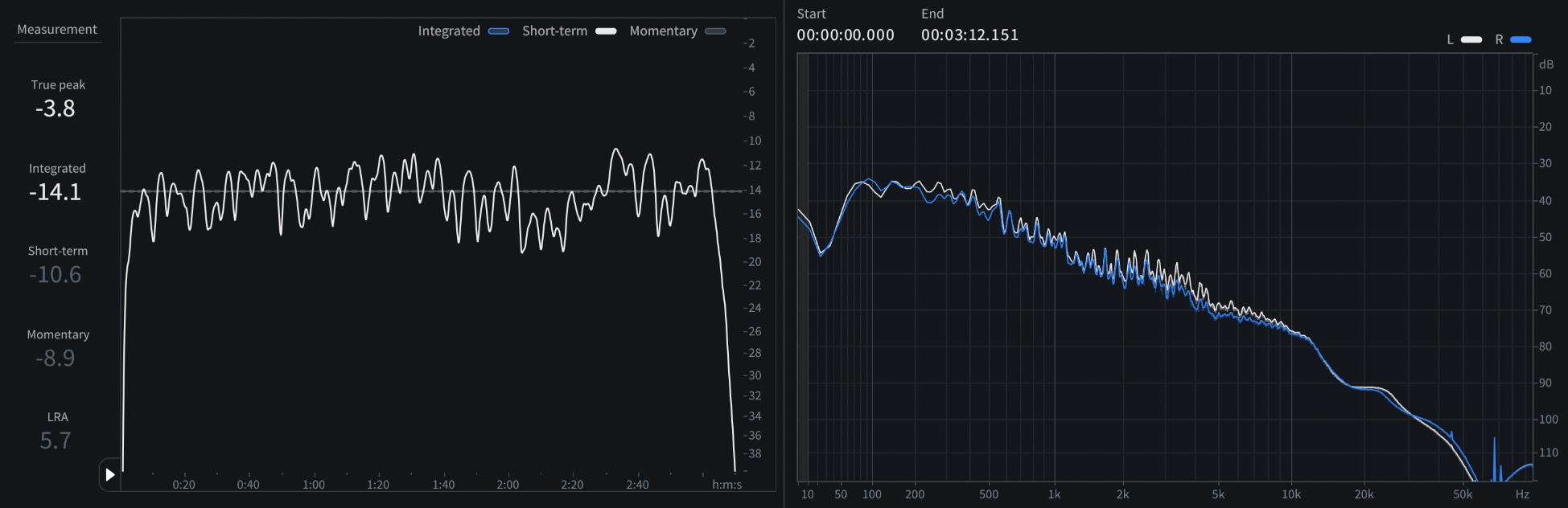
Short-term LUFS and spectrum of “The Christmas Song (Merry Christmas To You)”, remastered
True Peak: -3.85 dBTP
Sample Peak: -3.86 dBFS
Int. Loudness: -14.1 LUFS
Loudness Range: 5.7 LU
The first thing we might notice is that from a purely “measurements and specs” standpoint, neither of them is particularly “loud” at -23.3 and -14.1 LUFS, respectively. Neither gets particularly close to full scale either, at -7.8 and -3.8 dBFS, respectively. However, there are some marked tonal and dynamic differences.
Listening to the first 13 seconds or so, it’s easy to find the remaster a bit more exciting. A little brighter, a little louder, a little wider – generally just a little “more.” It doesn’t take much of the vocal being in to hear the shortcomings of that approach, though. Comparatively, Nat’s vocal in the remaster just feels a bit flat – dynamically, not in terms of intonation – and distorted. One of the best ways I can think to describe it is that the original feels like a performance, and the remaster feels like a facsimile.
And here’s the thing: the original sounds just as loud, if not perhaps a bit louder at the climaxes, than the remaster. Moreover, it sounds just as loud, if not a bit louder, than just about any other song in this list at -23.3 LUFS.
8. “Underneath The Tree” by Kelly Clarkson
Producer(s): Greg Kurstin
Mixing: Serban Ghenea, John Hanes
Mastering: Chris Gehringer
Release Year: 2013
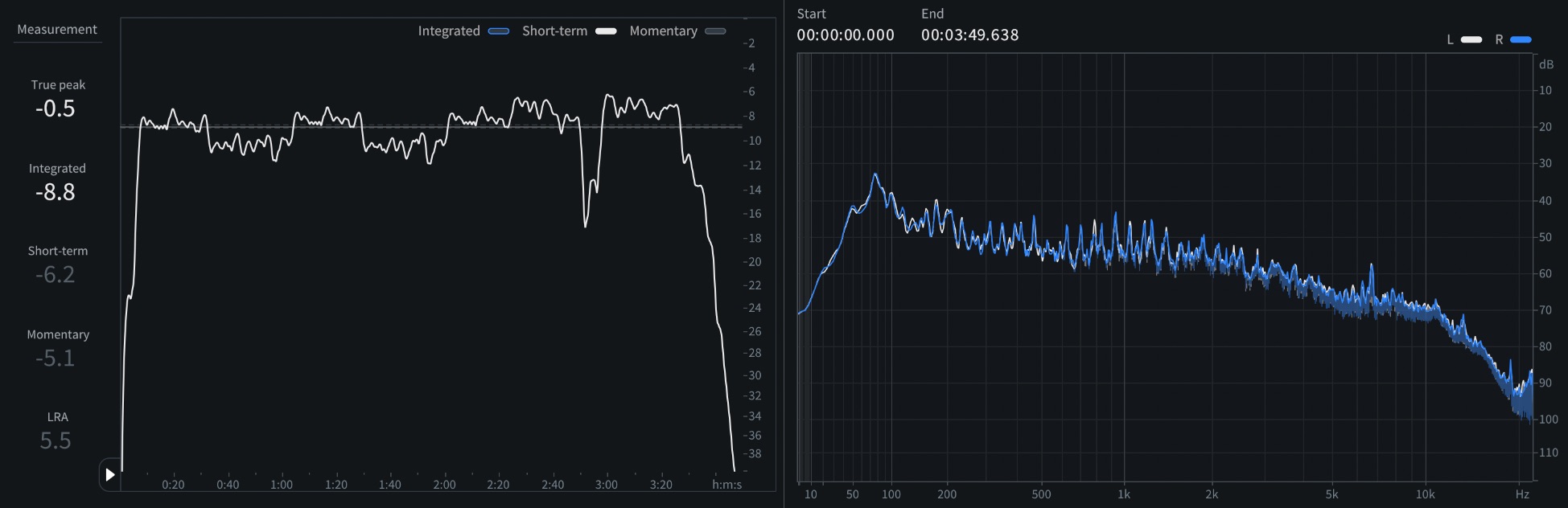
Short-term LUFS and spectrum of “Underneath The Tree”
True Peak: -0.49 dBTP
Sample Peak: -1.11 dBFS
Int. Loudness: -8.8 LUFS
Loudness Range: 5.5 LU
After that last one, Kelly Clarkson’s “Underneath The Tree” sounds, well, almost quiet. And it’s at -8.8 LUFS, which is technically the loudest in the list. So LUFS and loudness normalization are clearly conspiracies and/or entirely broken, right?
Not so fast. First of all, this is still a stellar mix and master, again by another variation of the modern-day dream-team, so let’s not discount that. Second, with a little context and understanding of the technicalities of LUFS, we can make perfect sense of this. We’re nearly there, let’s listen to a few more and then pull it all together.
9. “Sleigh Ride” by The Ronettes
Producer(s): Phil Spector
Mixing: Larry Levine
Mastering: Unlisted
Release Year: 1963
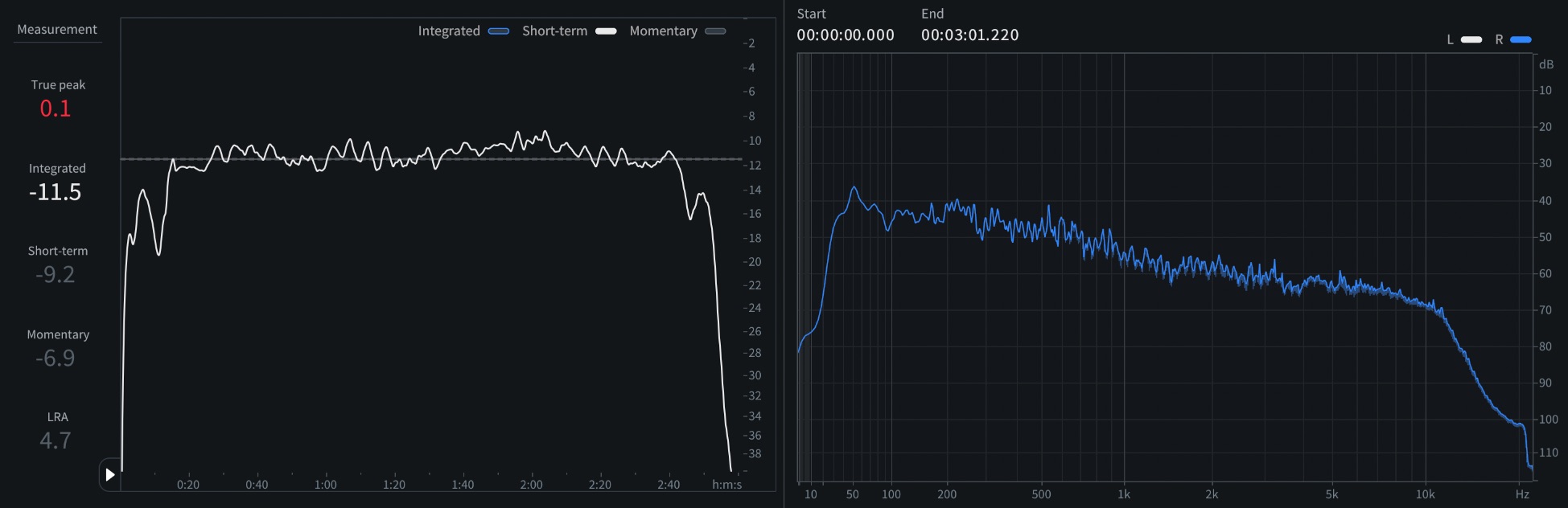
Short-term LUFS and spectrum of “Sleigh Ride”
True Peak: 0.11 dBTP
Sample Peak: 0.00 dBFS
Int. Loudness: -11.5 LUFS
Loudness Range: 4.7 LU
Another tape transfer, back to mono, and another opportunity for some RX cleanup in the beginning. Honestly, though, the more mono mixes I listen to, the more great modern learning opportunities I think there are to be taken from them.
The thing that strikes me here is, again, the care in arrangement and recording of balancing sustained and staccato elements in different frequency spaces. Everything has its place, and nothing is there without a purpose or intent. Additionally, it has to be said that for a mono recording, there’s an awful lot of depth. Like other songs in this collection, it looks to be a (more or less) straight digital transfer from tape, or at least one without any limiting. Yet it still clocks in at -11.5 LUFS.
10. “It's Beginning To Look A Lot Like Christmas” by Michael Bublé
Producer(s): David Foster
Mixing: Jochem Van Der Saag
Mastering: Vlado Meller
Release Year: 2011
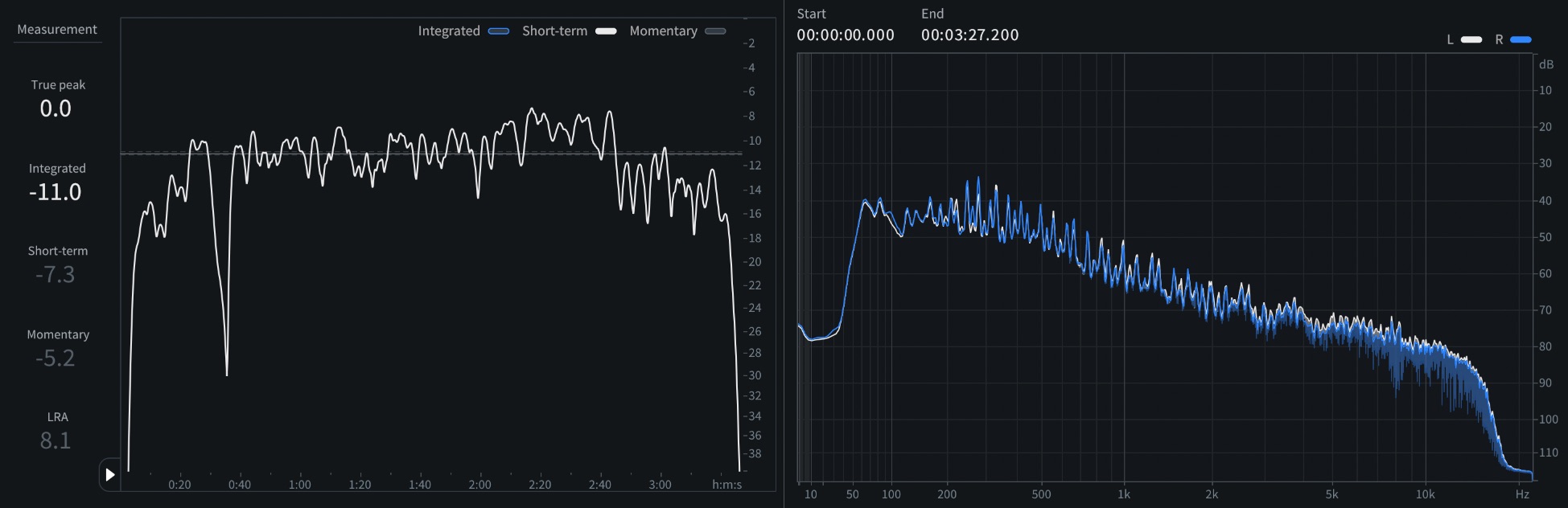
Short-term LUFS and spectrum of “It's Beginning To Look A Lot Like Christmas”
To round out our Christmas list, we have Michael Bublé’s modern take on “It’s Beginning To Look A Lot Like Christmas.” With sample peaks right up at -0.05 and an integrated level of -11 LUFS, it’s more endemic of what we might expect from a Mariah, or Ariana, or Kelly, and yet, in some respects, it has more in common with Nat “King” Cole. Certainly, the vocal tone and level balance, paired with the strings and the rest of the arrangement, seems to take some inspiration from those classic recordings.
And what do we find with the perceived level? Well, sure enough, it sits alongside the original version of “The Christmas Song (Merry Christmas To You)” pretty comfortably. If you’re not starting to put the puzzle together yet, I’m about to give you a big head start, but first...
11. “The Chanukah Song” by Adam Sandler
Producer(s): Adam Sandler, Allen Covert, Brooks Arthur
Mixing: Gabriel Veltri
Mastering: Stephen Marcussen
Release Year: 1996
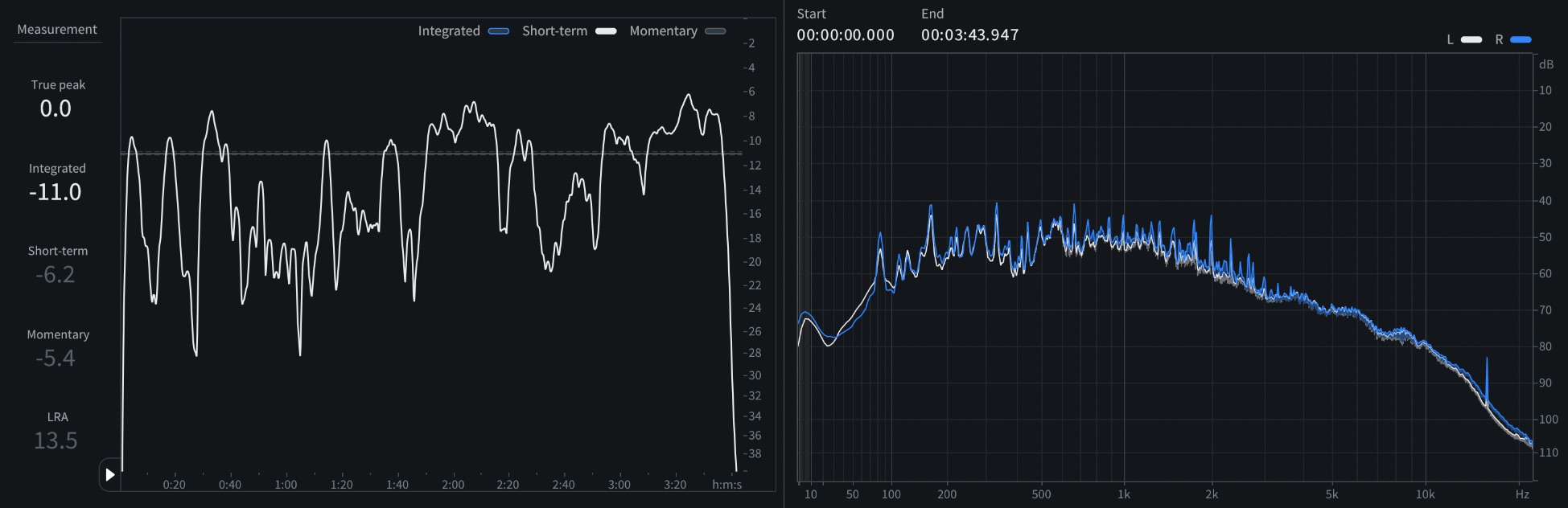
Short-term LUFS and spectrum of “The Chanukah Song”
True Peak: 0.04 dBTP
Sample Peak: -0.12 dBFS
Int. Loudness: -11.0 LUFS
Loudness Range: 13.5 LU
I just had to include this. We’ll leave it out of our official analysis, but do you know how excited 11-year-old Ian was to have a Chanukah song – by Adam Sandler, no less – that he could point to around the holidays when stores and airwaves were dominated by Christmas music? So, as we reflect on what we can learn from our Christmas songs, here’s a little Chanukah ditty.
Meta-analysis and reflection
First of all, let’s take a quick look at how the overall numbers stack up against our longer-running averages and trends.
| 2025 Trends | Holiday 100 | |
| Avg LUFS, Int | -8.3, ±1 | -12.9 |
| Max LUFS, Int | -6.0 | -8.8 |
| Min LUFS, Int | -11.1 | -23.3 |
| Avg LUFS, S-T | -6.1, ±0.99 | -9.2 |
| Max LUFS, S-T | -3.6 | -5.4 |
| Min LUFS, S-T | -7.8 | -17.9 |
| Avg LRA | 5.5, ±1.5 | 7.0 |
| Max LRA | 10.8 | 13.5 |
| Min LRA | 1.4 | 3.5 |
Now, it shouldn’t be surprising that the averages are lower: after all, we have a song that’s a -23.3 LUFS. However, notice that it’s not just the averages, but the lower maximum values – or in the case of LRA, higher – and even if we eliminate all the releases prior to 1994, this remains true. Average LUFS, integrated, comes up by 2 LU, but maximum short-term actually goes down by 0.8 LU. So, one of the first things we could say is that the most popular Christmas music out there tends not to be pushed as loud.
But that’s not really the most interesting part. The thing we kept coming back to is that somehow, a song that’s at -23.3 LUFS sounds louder on streaming than ones that are at -10 and higher.
Why do old Christmas songs sound so loud on streaming services?
Here’s what’s going on here, and it’s a combination of a few things:
- We need to understand some of the details of the LUFS measurement algorithm, particularly the K-weighting filter.
- We can think about the specifics of not just a song’s LRA, but where that LRA tops out.
- We should familiarize ourselves with the idea of “acoustic advantage.”
K-weighting filter details
First, let’s talk briefly about the k-weighting filter. In short, it’s a filter applied to LUFS measurements that rolls off frequencies below about 100 Hz and applies a 4 dB high shelf boost starting at 1 kHz and at its maximum by 2 kHz. This is meant to simulate the sensitivity of the human ear to different frequencies. In practice, it means the very low frequencies contribute less to measured loudness, while higher frequencies contribute more.
On the surface, that makes sense. But one problem is that our sensitivity starts to drop off above about 6 kHz. Again, in practice, this means that a modern production with very extended high frequency will measure as “louder” – all else being equal – than an older recording with a more natural, rolled-off high end. Because of that, it will be turned down more on streaming. Here, compare the spectrums of Nat “King” Cole’s “The Christmas Song (Merry Christmas To You)” with Kelly Clarkson’s “Underneath The Tree.”
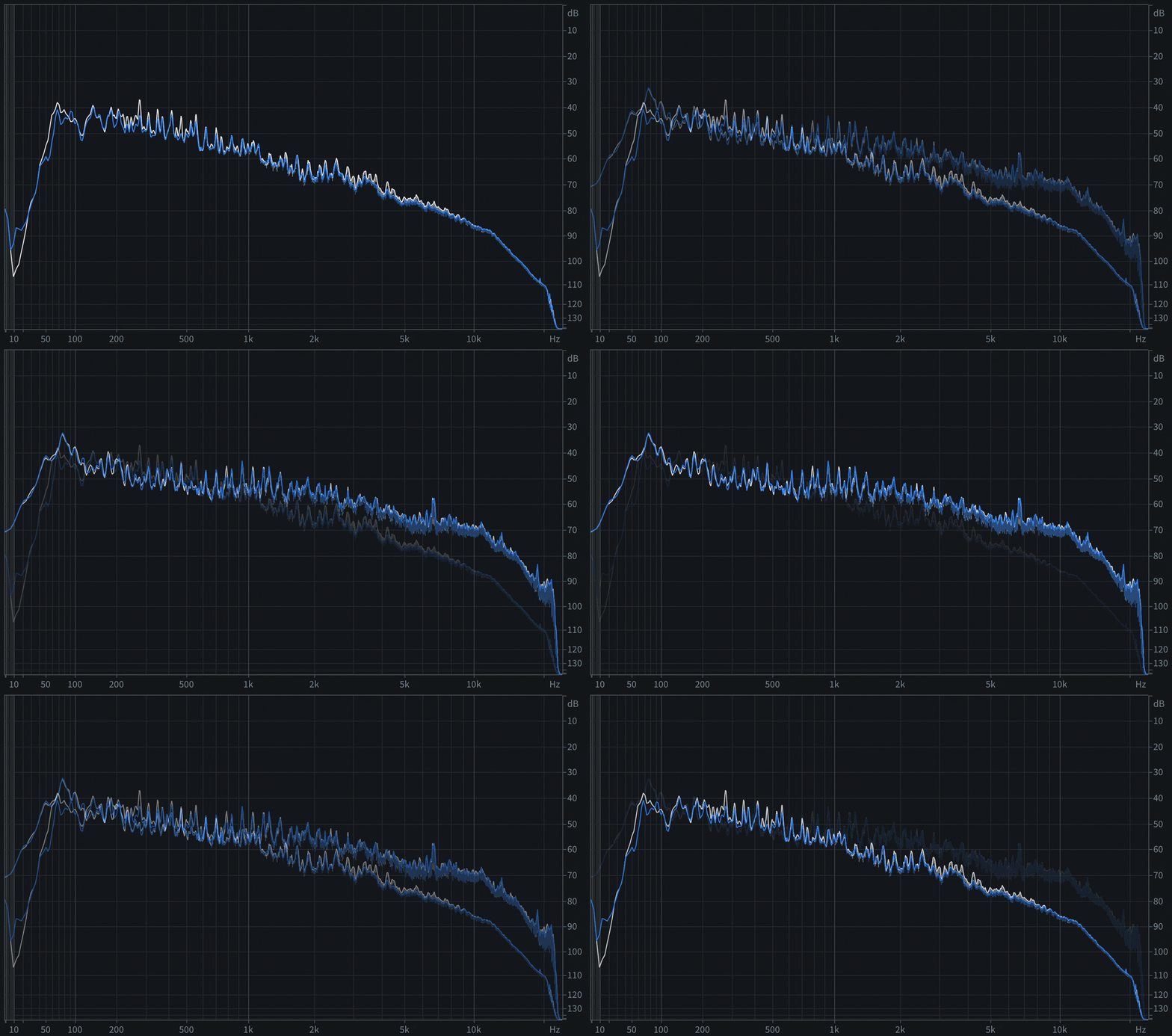
1961 vs 2013 spectrums
Note that the amount of energy is very nearly the same at about 1 kHz, but that above that, the older song has a much gentler high end.
How does LRA factor in?
Next, let’s check out LRA. Specifically, I want to use a feature in WaveLab that allows us to visualize not just the range covered by LRA, but also where the upper and lower bounds of that range are, song by song. I’ve normalized all songs to -16 LUFS, integrated, as they would be on Apple Music, and the yellow lines in the image below show the top and bottom of the loudness range for each song.
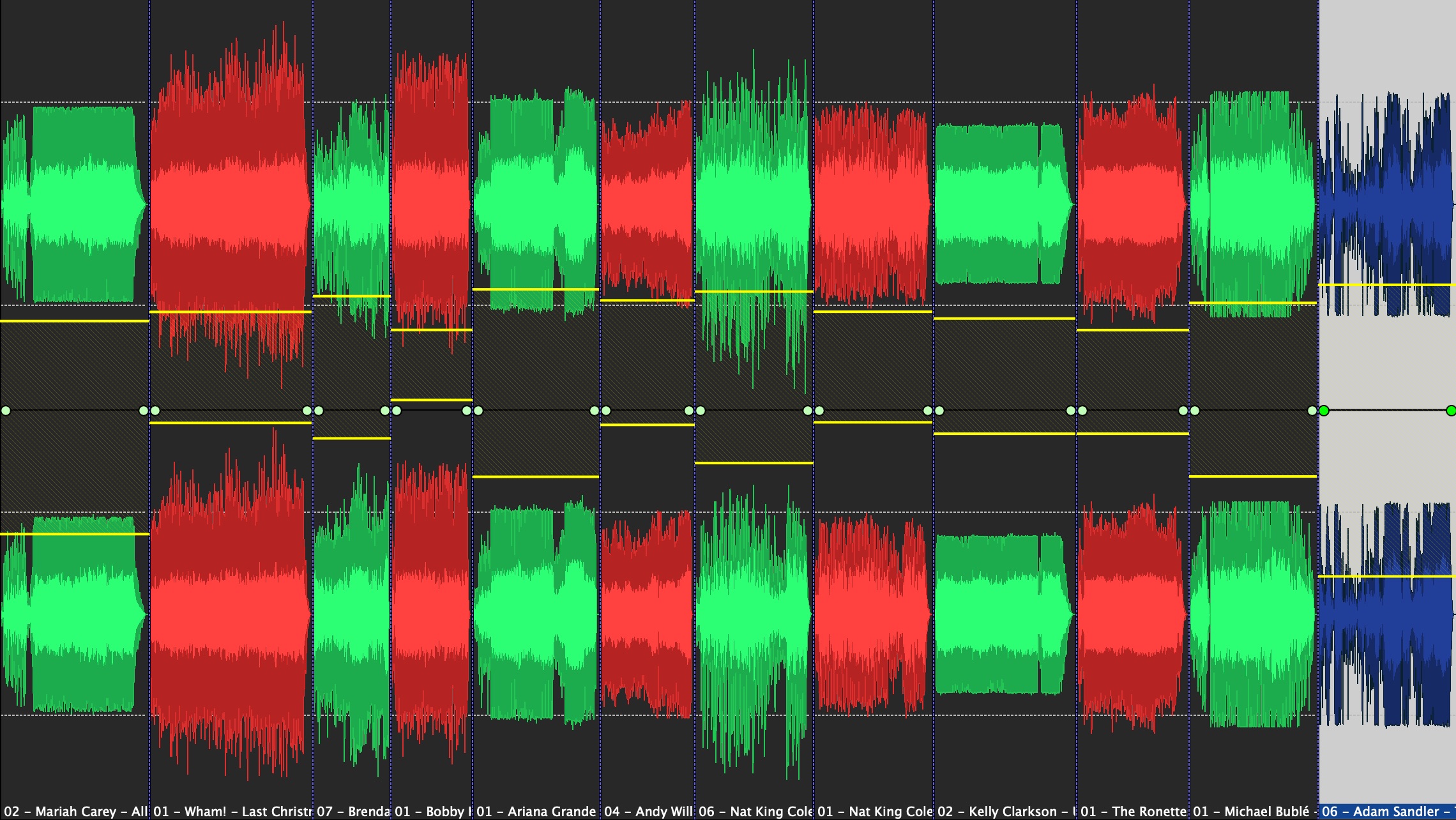
LRA of all songs under analysis
One trend that pops out pretty quickly to me, is that the songs with a higher “top of LRA” with the ones that sound subjectively louder. Coincidence? I think not.
What is the “acoustic advantage”
Lastly, the so-called “acoustic advantage” is the observation – long understood in mastering circles – that a song which is a predominantly acoustic arrangement will sound louder than a full-on amplified or electronic arrangement when set to the same measurable level. The reasons for this are a bit complex and deal with psychoacoustics – or the science of human hearing perception. It’s also tied to spectral density, which I talk about in our guide on loudness.
In a nutshell, though, as spectral density increases, so does the average measured level. However, this does not necessarily correspond to an equal increase in perceived loudness. The details are highly complex, and we don’t have room to go into them here. Suffice it to say: no, LUFS measurements and loudness normalization aren’t broken, they’re just slightly imperfect systems in which context and details are important. They’re also better than previous methods of measuring and matching loudness. And crucially, both of those things can be true, without also meaning that we can’t explore other – and potentially better – methods of measuring and matching loudness in the future.
Start analyzing your own tracks
So let’s leave this vintage vs. modern mastering discussion there for today. But keep an eye out for more analyses down the road, and be sure to let us know over on Instagram if there are any particular charts, genres, or songs you’d like to see analyzed.
If you want to explore these ideas in your own work, iZotope offers tools designed to make analysis intuitive. Tonal Balance Control lets you compare your track’s frequency spectrum against reference tracks from hit songs, while RX provides detailed spectrographic analysis to support visually informed decisions.
Explore iZotope’s analysis tools like RX, Tonal Balance Control, and Ozone to start refining your sound with a deep understanding.