
Table of Contents
If you caught our previous deep dive into the Emmy-winning sound of FX’s The Bear, you know how Supervising Sound Editor and Re-recording Mixer Steve “Major” Giammaria, Dialogue Editor Evan Benjamin, and Production Sound Mixer Scott D. Smith built the show’s signature kitchen chaos.
Now, as the series comes to a close with Season 5, the team faces a whole new set of sonic challenges – from practical rain rigs streaming down restaurant windows to fifteen characters shouting at once and some of the quietest, most emotionally intense scenes of the entire show.
We sat down with Major, Evan, and Scott to look back on how they crafted the audio for The Bear’s epic final season.
The Bear interview
In Season 5, nature and the crumbling restaurant almost become characters. How did these wet, noisy environments test you all, and how did RX help preserve on-set dialogue?
Scott: Our approach on set was to work with the FX department to minimize the sound of the water hitting surfaces inside and outside the set, (especially against the windows). We had about 5 rolls of sound-dampening “hogs hair” matting, which we put everywhere we could off camera. The FX department also used special spray bars for the rain that were quieter than typical spray rigs.
The other thing that we fought for was to try and keep the FX noise consistent within the scene, which makes it easier to dial out in post. All of the mics we used (along with the boom operators!) had to be waterproofed, which added to the prep work for a scene. Even with those precautions, there were instances where the mics were completely drenched by the high pressure nozzles.
 Evan Benjamin, Steve “Major” Giammaria, and Scott D. Smith
Evan: As in all the previous seasons, iZotope RX was an integral part of my workflow in wrangling the dialogue into shape for this show. Rain definitely took things up a notch, and just meant I had to work a little harder to create a smooth and convincing edit. RX, as always, allowed me to save countless lines by careful use of the spectral editor to remove the kind of things that would make ADR necessary previously. I found that copy and pasting sometimes was more useful than simply using the “replace” function.
Major: Scott does an amazing job capturing, and Evan cleaning, so that when it gets to me, I just have to not mess up their wonderful work. It’s a light touch, fader and EQ, light compression. Always letting the performance come through.
The Bear’s overlapping dialogue evokes so much chaos and angst. Scott, how did you capture 15 characters at once in Season 5? And Evan, what changed about editing dialogue for that many competing voices?
Scott: As it has been since the beginning, overlapping dialogue for The Bear has become the norm. While we fought for clean lines wherever they could be had, it was mostly a losing battle. (I’ve worked in post-production, and know full well what a nightmare this is for sound editorial and mixing). We typically use a combination of booms, plant mics and lavaliers. However, even when we have relatively clean pickup on the boom mics (which is what I always strive for), it’s sometimes necessary to revert to the lavs when needing to extract specific dialogue from the chaos.
Evan: With overlapping dialogue, I would often resort to the spectral editor to see if I could draw out the other voice. Sometimes I could do this relatively easily, other times I had to settle for removing what I could and searching for other takes to fill in the blanks, the issue being on The Bear that there aren’t that many takes and they’re usually quite different from each other. So my other option was to use the lav mic for the overlap. There would still be some of the other voices on it, but usually much less so. And that would also make it easier to discern the visual differences.
Major: In those chaotic scenes there is often a lot to hide behind. Evan does his best to clean up overlaps, but if there’s a bit of doubling up, a nice pot clank or dish rattle usually masks things well!
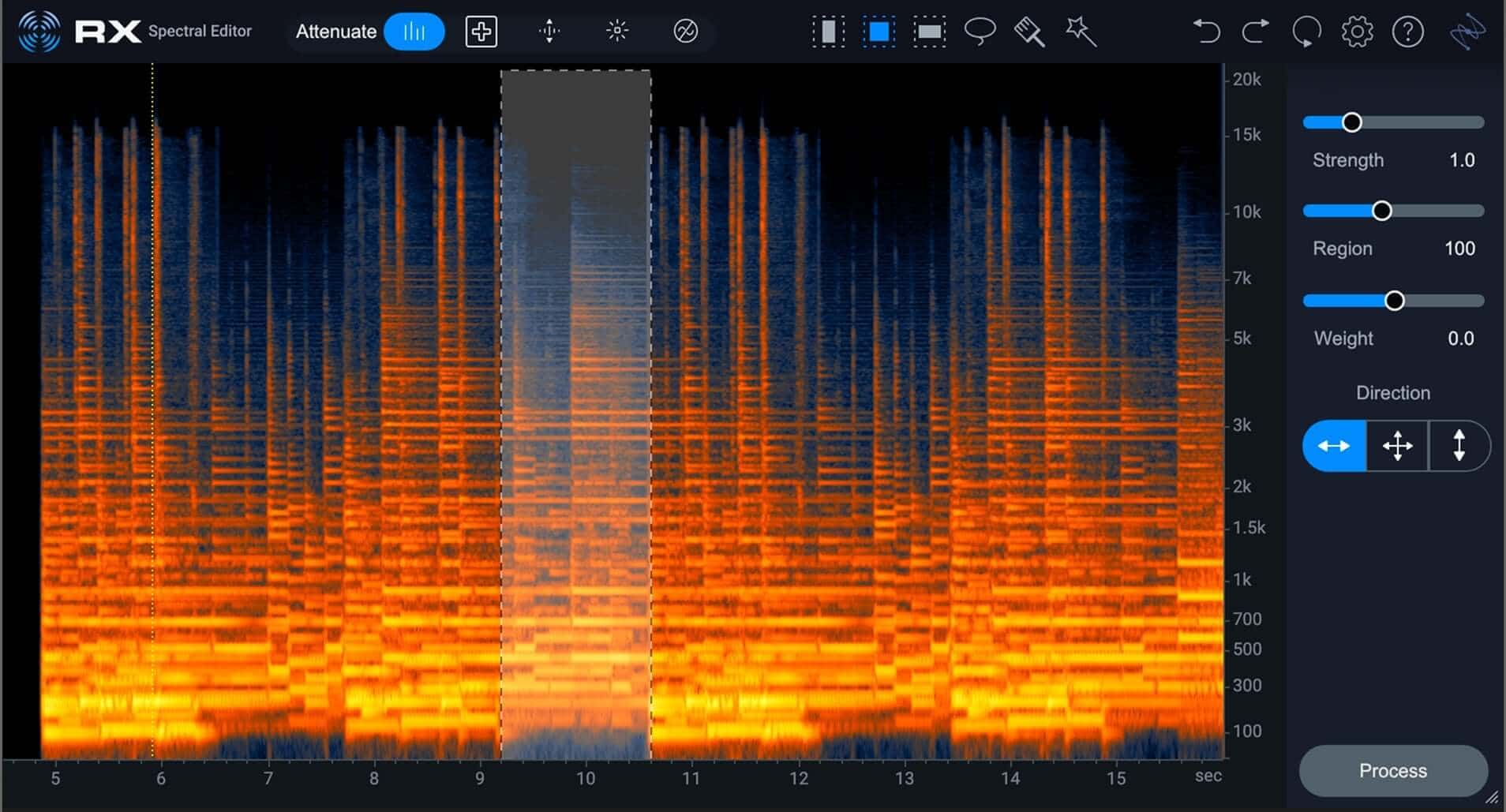 iZotope RX 12 Spectral Editor
Silence is a tool that The Bear uses skillfully, punctuating the most tense and emotional moments throughout the show. How did you employ silence and create a sparse ambience without it sounding unnatural?
Evan: Probably more of a question for Major, but I found that getting rid of noise is sometimes easier than deciding what noise is useful. And paradoxically, sometimes the best way to convey “silence” is to have some small movements and mouth noises left in the mix.
Major: Those sparse quiet scenes are much more difficult than the flashy loud sequences that we are known for. If it’s just Claire and Carmy on a stoop, or Richie and Sugar in the office, there’s nothing to hide behind. Every breath, every noise, every moment in between sounds, has to be considered for its emotional impact. We often have very intricate “quiet” backgrounds that have many layers that sound like “silence” but are actually very rich with movement and depth that really helps us keep the dialogue from becoming sterile. If there’s a world for your production dialogue to live in, you can let it breathe and really only attack the noises that distract.
Season 5, Episode 6 shows the sharp contrast between the kitchen and front-of-house. Sonically, how did you establish the boundaries between these two worlds? How did you use sound to represent the tension leaking from the kitchen into the dining room?
Scott: We had a very extensive setup for that episode. The set was constructed specifically for that episode, which mirrored the interior of the set we used for all the other interiors, except that the wall along the length of the set from back to front were open to accommodate the dolly shot. The rest of the set was fully intact (including the ceilings).
When we did the first camera run-through for the setup, it was obvious that it was going to be extremely difficult to get boom mics into the set anywhere, since we couldn’t come from above due to the ceilings. In the end, we were able to have two boom ops dance around the camera angle in the kitchen area (blocked in part by the soffits), but there was nowhere to hide in the front of the house.
Ultimately, it required the use of a Fisher 26 foot boom, which allowed us to get above the camera, and reach at least ¾ of the way to the back of the set. While we also had mics on the actors, the sonic signature that defines the two different sections of the set would have been totally lost without the boom mics.
That setup alone involved a sound crew of 10 people (including two production mixers).
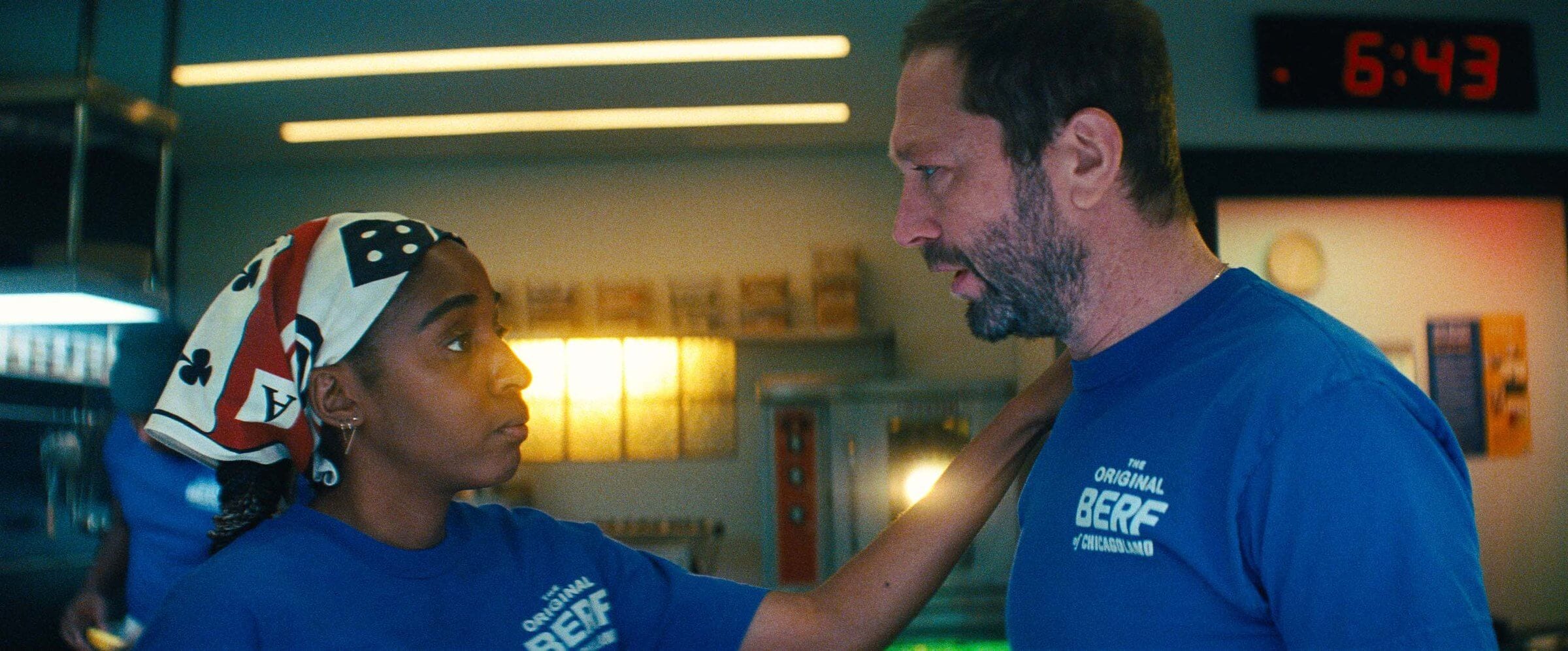
Major: We decided early on that like the Season 2 finale, the wall between the dining room and kitchen was magical. You do not hear any bleeding between the two unless the door is open (and even then really only if there’s room for it). In Season 5 there was a different kind of environment in the kitchen. Even though things were going wrong, Syd was in charge and everyone’s movements were different. There were less people in the kitchen than Season 2 as well, so everything was a bit more sparse and precise.
Evan: Scott gave us lavs on everyone in both worlds continuously, so we could have total control over both sides of that world. I just tried to organize them as logically as possible (there were a lot of them!)
What was the biggest challenge from Season 5, and how did you address it? Were there any specific RX modules that were indispensable?
Evan: The biggest challenge was likely the scene with Syd and Carmy outside in the rain as she discovers his cigarette butts likely caused the water issues in the restaurant. Or possibly the scene between Syd and Marcus in the same location. Just a lot of shifting tone back and forth. I mostly use Declick and the Spectral Editor. But truthfully, those scenes needed mostly old fashioned dialogue editing, and a lot of it.
You’ve now all been awarded multiple Emmys for your masterful sound work for The Bear. How do you maintain that level of excellence, and make sure each season sounds better than the last?
Scott: Once we were able to get a handle on how the show was shot, we were able to tweak our approach to address problems that we knew would exist from episode-to-episode. A big part of the challenge for us was to figure out what the cameras were going to do, as there are few (if any) rehearsals, and the camera ops tend to go by instinct for framing a shot. This requires a constant back-and-forth between the boom ops and camera, which is really a challenge when you’re in the middle of a scene.
As the show progressed season-to-season, we were also able to solve some issues relating to offstage noise and RF (radio frequency) interference, which in a multi-stage complex can be substantial.
Evan: I think you just come to work every day and try to come up with new solutions for new problems, and try and get better at using these great tools that companies like iZotope make for our work. I really spend a lot of time trying to streamline my workflow so that there is no friction between having an idea and executing that idea. It helps that the show itself is so inspiring to work on.
Major: I am just so grateful to be associated with such an amazing show, and one that takes the power of sound seriously. I hope to bring the same level of detail to all my projects, and continue to help showrunners and filmmakers tell their stories.
For our independent filmmakers, sound editors, and dialogue mixers out there: what advice can you share for getting started, or leveling up their audio career?

And remember, after you’ve done all that, you still have to be able to read the room. Get your ego out of the room. Know what the client wants and give it to them. And you know what they want by listening to them, so do that. It’s their show, and you’re helping them tell that story.
Major: The craft is only part of the job. Be kind, be curious, be a good hang. It will take a lot longer to get where you want to be than you want it to. Make sure you enjoy the process.
Scott: In addition to the excellent comments from Evan – never pass up the opportunity to connect with those working in the industry (which is more of a challenge these days as the business has become more siloed than it was in the past). Besides learning equipment inside and out until you can work with it blindfolded, spend as much time listening as possible. If you have the opportunity to listen to material on different systems in different environments, it is a huge plus in understanding how the viewers will experience a soundtrack.
In the production world, it is absolutely necessary to learn on set. There is just no other way to understand all the various issues that you’ll be confronted with, as well as understanding the approach used by various sound teams. The equipment may be the same, but how it’s utilized can vary widely.
Get inspired by the sound team behind The Bear
These insights from Major, Evan, and Scott showcase the true craft behind The Bear’s iconic soundscapes. From mastering drenched outdoor sets to balancing high-stress kitchen overlap with quiet character moments, their work on Season 5 shows that audio isn’t just technical – it’s storytelling at its finest.
Looking to edit your scenes with the same processing? Try iZotope RX for free.