
Bringing a vision to life requires finding the perfect balance between story, performance, and technical precision. In director Alejandro González Iñárritu’s satirical comedy Digger (2026), starring Tom Cruise, the sound team was tasked with building an immersive world where comedy, tension, and absurdity sit side by side on a fine line.
We sat down with Academy Award-winning supervising sound editor and re-recording mixer Johnnie Burn to discuss how he shaped the sonic tone of Digger, tamed noisy VistaVision camera footage, preserved Tom Cruise’s on-set prosthetic-heavy performance, and integrated iZotope RX into his mixing workflow.
Digger interview with Johnnie Burn
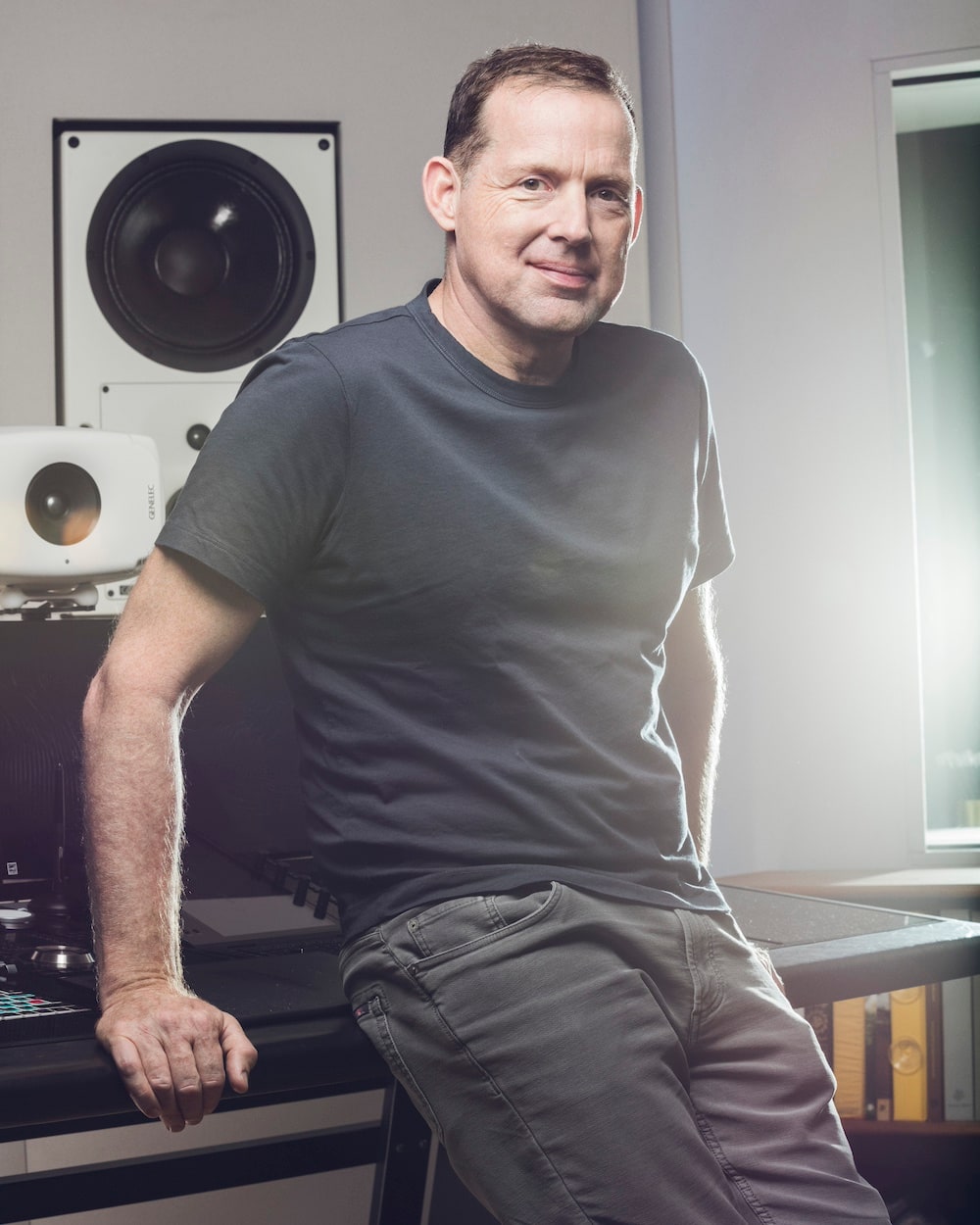 Supervising sound editor and re-recording mixer Johnnie Burn
How did you and director Iñárritu find the film's sonic tone, and how does building a sound world for satire differ from other films you’ve worked on?
Satire requires a particularly delicate balance. You can make something feel threatening, absurd, or funny with remarkably small changes in level, dynamics, and timing. Sometimes the difference between a joke landing and not landing is only a few decibels. It's weird too because satire is about exaggeration and hyperbole, but clearly not only that.
With Digger my team and I joined late in post which gave us an unusual opportunity to concentrate intensely on those nuances in the final editorial and mix.
Alejandro listens incredibly closely. We spent months exploring those distinctions, finding when the sound should press in on the audience and when it should give them enough space to register the comedy. Something that feels oppressive at one level can reveal its absurdity when you pull it back a little.
The film also changes your understanding of what you’re watching as it unfolds. Sound gives us a way to shape that relationship without explaining it. That was the fascinating challenge: finding a mix that could serve the comedy, and serve the perspectival shifts at the film's meta level, and bring enormous technical clarity, detail, immersion and originality, whilst feeling like it wasn't trying to do any of that stuff!
VistaVision is a notoriously noisy old camera. Can you walk us through how you dealt with camera noise in the production dialogue? Which RX tools did you use, and how were they helpful?
I’d already had an opportunity to investigate ways of managing VistaVison camera use on soundscape while preparing for Bugonia. We tested it extensively before shoot to make sure I had a method to get rid of the extreme noise, and that gave me very useful experience to draw on for Digger.
Key to all of it is the painstaking work on every phrase at that moment where the air starts to leave an actors lungs at end of a phrase and your signal to noise ratio tanks right when they are ending a word with a subtle ‘f’ or 's' sound, and then everything goes ‘quiet’ at 85 dB. So dialogue editor Simon Carroll and my team spent a few weeks working on processes we had established in the past to see what we could do.
Our first pass is in iZotope Spectral De-noise, taking out perhaps six or seven decibels of noise rather than trying to solve everything at once.
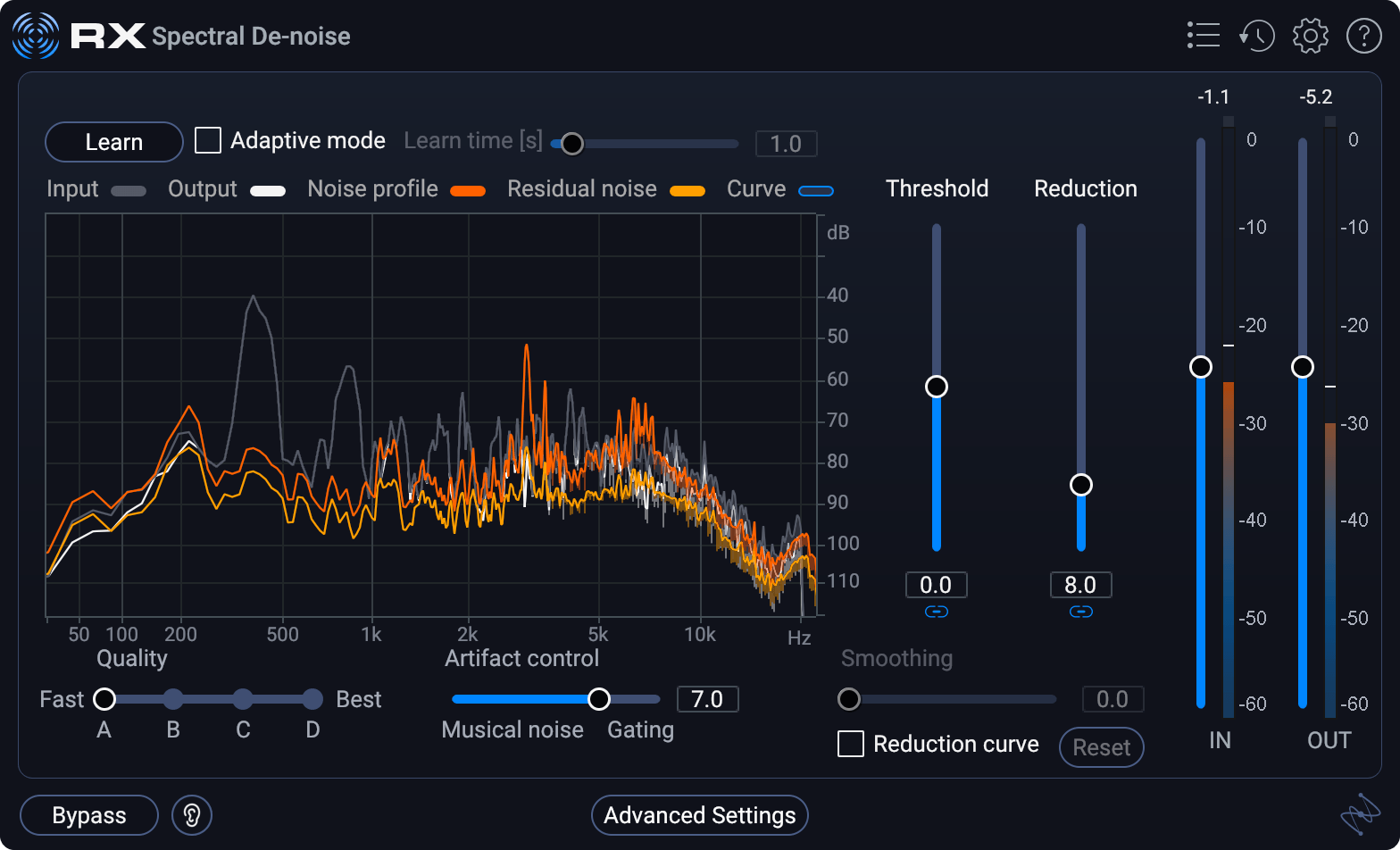 iZotope RX Spectral De-noise module
After that we would use dxRevive on the mid-range frequencies, plus occasional RX Spectral Repair to paint out specific remaining artifacts and unwanted sounds. On a few difficult clips notably in the scene just before the big Digger speech, we used Hush Camera tool.
I’m particularly careful to preserve the high-frequency detail, because I find you can lose your connection with a character when too much of that disappears. It can be really useful to put a dividing line in around 2 kHz and treat the upper and lower frequencies on that as different processes.
The important thing is listening to what you’re losing as well as what you’re removing. A blanket approach can take away the tiny details that make a voice feel human, particularly the texture in consonants, breath, and sibilance.
That has a dramatic consequence. You can find yourself feeling more distant from a character even though the dialogue is technically cleaner. We’re trying to remove the camera while keeping the person. RX is enormously useful because it lets us work carefully on individual problems rather than treating every recording in exactly the same way.
With sustained, raised dialogue, perspective becomes especially important. A close lavalier recording can feel relentlessly near, so part of the mix was finding the right sense of distance and space around those voices. That mattered both within each scene and as the film changed our understanding of what we were watching.
Tom Cruise is nearly unrecognizable in prosthetics and a thick Southern accent. Did the makeup and accent affect the production dialogue, and how did you approach preserving his on-set performance vs. turning to ADR?
Tom and I actually discussed this. The prosthetic around his chin seemed to affect the sound reaching the lavalier microphone, particularly in the lower-mid frequencies. It was an unusual change in the color of the recording, and something we had to take into account alongside the camera noise.
With such a distinctive voice and accent, the aim was to preserve the character of his delivery while making sure the words remained intelligible. We addressed problems line by line rather than trying to make the whole performance conform to some uniform idea of clean dialogue.
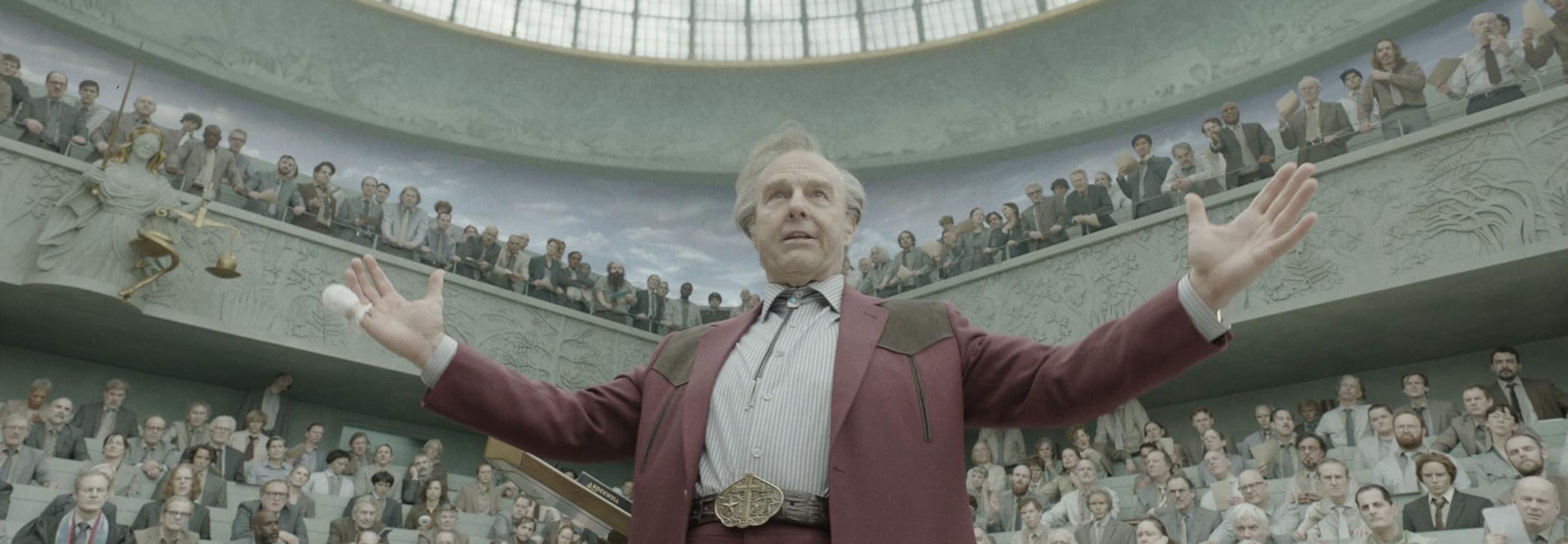
Above all, we wanted to retain his on-set performance wherever possible. That extended speech is phenomenal. There’s an energy and immediacy to it that we didn’t want him to have to reconstruct in an ADR studio. Preserving the feeling of that original performance mattered enormously.
You served as both supervising sound editor and re-recording mixer on Digger. How does wearing both hats shape your decisions?
I spent the first 15 years of my career in advertising, where I was used to recording, editing, designing, and mixing. You’re on your own, so you have to be very good at everything.
That shaped how I think about sound design and frame it more in the Walter Murch paradigm of holistically understanding the entire soundscape of a film – how it is presented to the audience in terms of content, level, placement, and relationship with everything around it as part of its overall design.
The distinction between sound editor and mixer is ultimately an arbitrary one. It’s professional, not creative. It’s a division of labour we’ve invented, but that delineation has nothing to do with how an audience experiences the soundscape, emotionally, sensorially or narratively.
So I edit as I mix, and I mix as I edit. Sometimes a problem that appears to need more design is solved by taking something away or changing its perspective. Equally, mixing can reveal that you need a different sound altogether. Carrying responsibility across editorial and mixing allows me to keep following the same creative thought through to the end. That’s the most fulfilling part: just ‘doing the sound’ and hearing an idea become an experience for an audience.
Beyond dialogue cleanup, where does iZotope fit into your toolkit? Are there RX modules you lean on creatively?
RX is something I use all the time, but a recent experience made me think differently about where restoration tools can be useful.
I was working with a major recording artist recently, and they showed me how they use RX De-click on a finished music master. It was addressing thousands of tiny events across just a few minutes of music, and I was struck by the clarity they achieved.
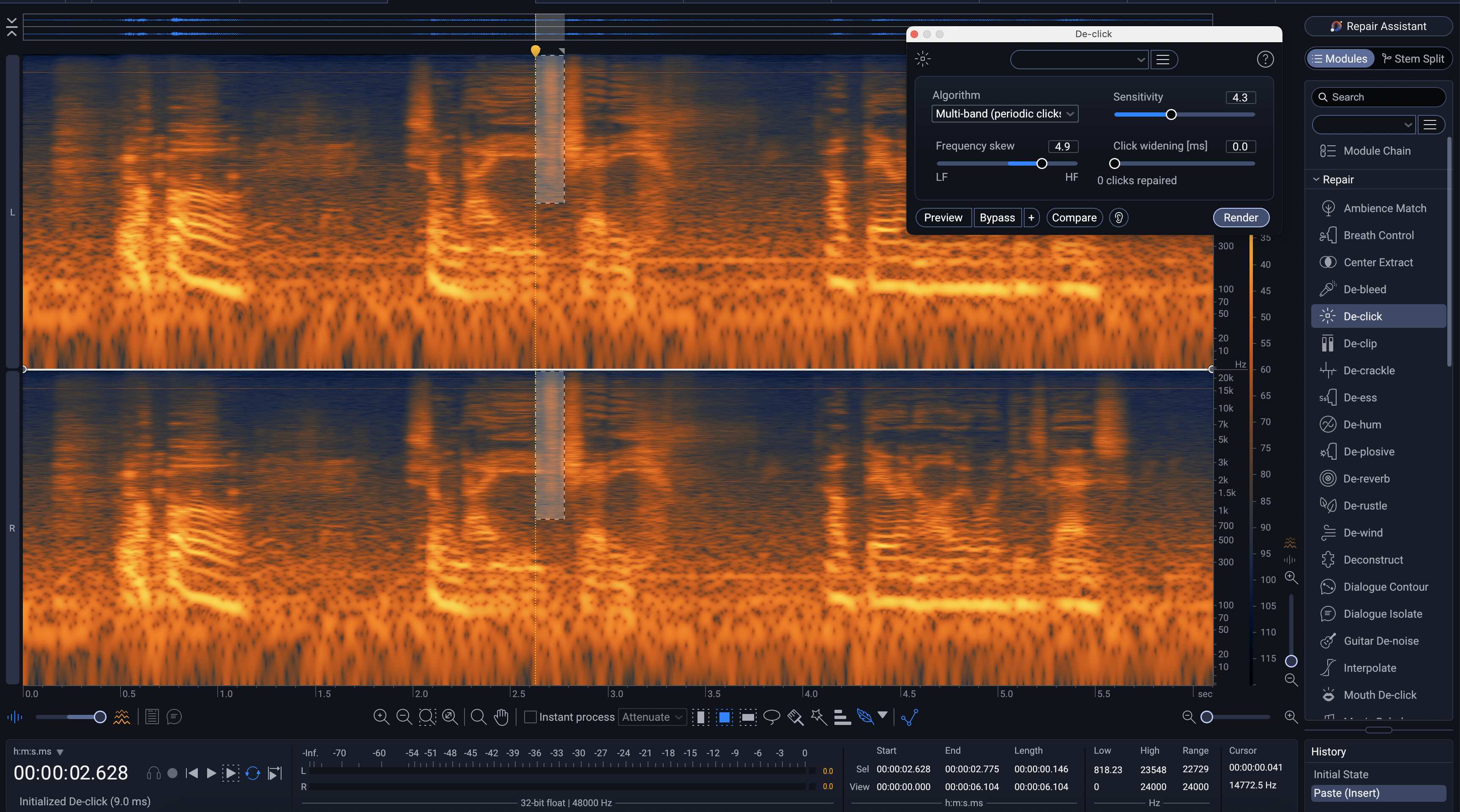 iZotope RX De-click module
It reminded me of carefully cleaning an old photograph: suddenly you notice detail that was harder to see before. Of course, you have to listen closely and compare, because you want to preserve the intentional attacks and textures.
I’ve started incorporating that approach into my own workflow – it proved very useful on sweetening textures that are not inherently transient-heavy. It reminded me that restoration tools aren’t only there to rescue damaged recordings, they work on already good stuff too!
That sort of clarity fascinates me. Paul Massey’s beautiful mix for A Complete Unknown is something I particularly admire in that respect.
For independent sound designers and re-recording mixers hoping to build their career, what advice would you share?
Find people whose work excites you and whom you enjoy working with. Then do everything you can to become someone they trust creatively.
Some of the most important relationships in my career began when we were all starting out. We weren’t thinking strategically about where anyone might end up. We liked making things together, and those relationships grew through the work.
A good collaboration gives you room to experiment, make mistakes, and develop a shared language. That can stay with you for decades.
So concentrate on doing good work, being generous with your ideas, and listening properly to other people’s. Build relationships around making things you care about together. You can grow a long way alongside one another.
Elevate your post-production workflow
Whether you are restoring production dialogue affected by vintage cameras and prosthetics or refining textures in your mix, having surgical restoration tools is essential. Explore how iZotope RX can clean and refine your next film project.