
Table of Contents
- Frequency Check results
- September 23, 2026: What's your biggest headache when mixing vocals?
- September 14, 2026: What is your most trusted source for verifying a mix?
- September 8, 2026: What technology has made the biggest impact on your audio production?
- September 1, 2026: What sound hurts your soul the most?
- August 25, 2026: How are you saving the mix today?
- August 18, 2026: How’d you learn to make music?
- August 11, 2026: What’s the most challenging for you?
- Where do you fall on the spectrum?
Welcome to Frequency Check, your weekly pulse on how the audio community approaches mixing and mastering. Every week in the iZotope newsletter, we ask engineers, producers, and creators a new question about their workflows, favorite techniques, and hot takes – then we break down the results right here.
Read on to see how your approach compares to others and where you fall on the spectrum this week. And if you’re interested in contributing to our weekly survey, sign up for the iZotope newsletter below.
Frequency Check results
September 23, 2026: What's your biggest headache when mixing vocals?
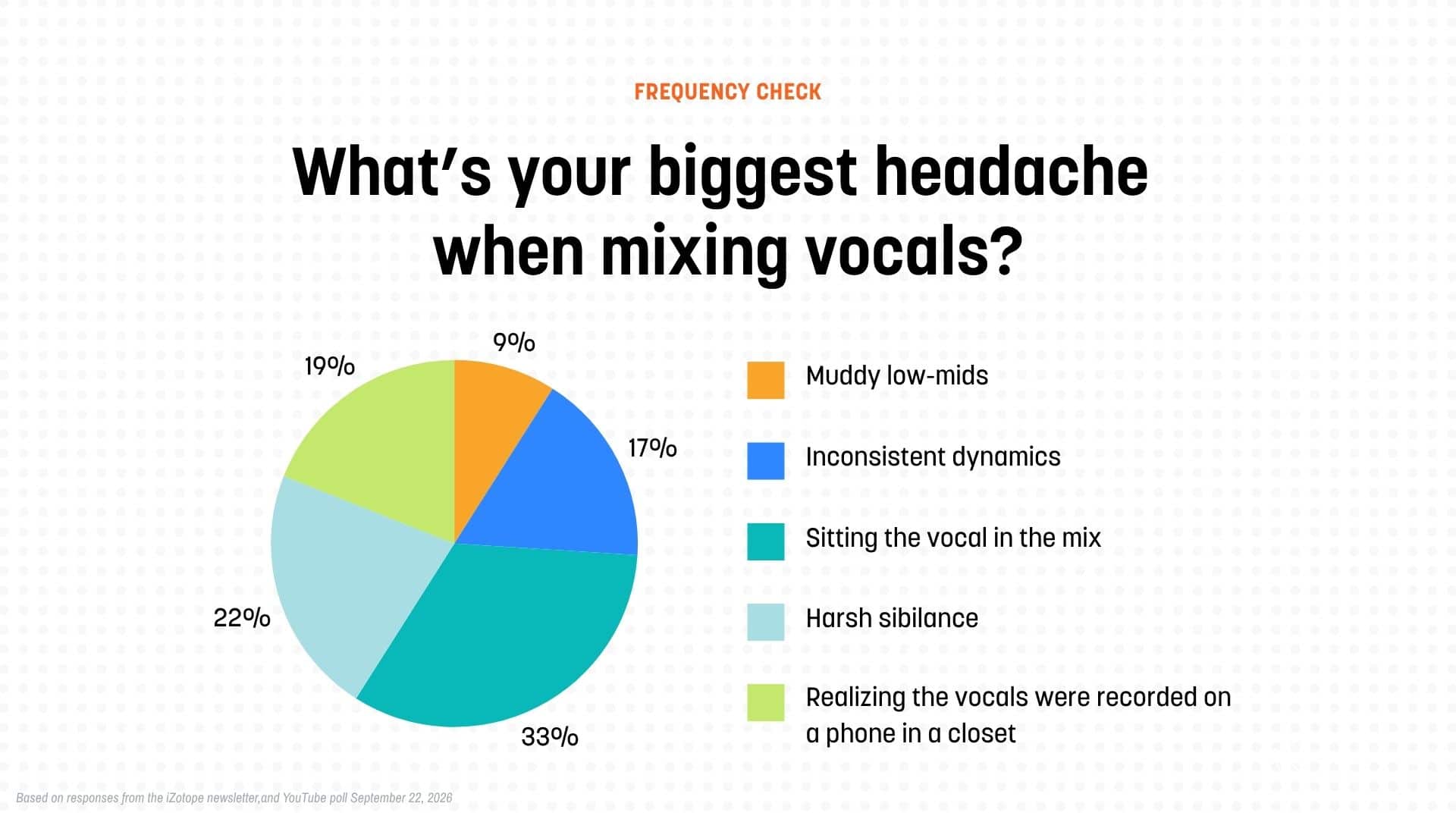
Getting a vocal to sound radio-ready is equal parts technical skill and raw damage control. Taking the top spot with 33% of the vote is sitting the vocal in the mix—finding that sweet spot where lead vocals sit snugly in the track without getting swallowed or floating unnaturally on top. Dynamic and tonal issues followed closely: 22% named harsh sibilance as their biggest annoyance, 17% struggled with inconsistent dynamics, and 9% pointed to muddy low-mids.
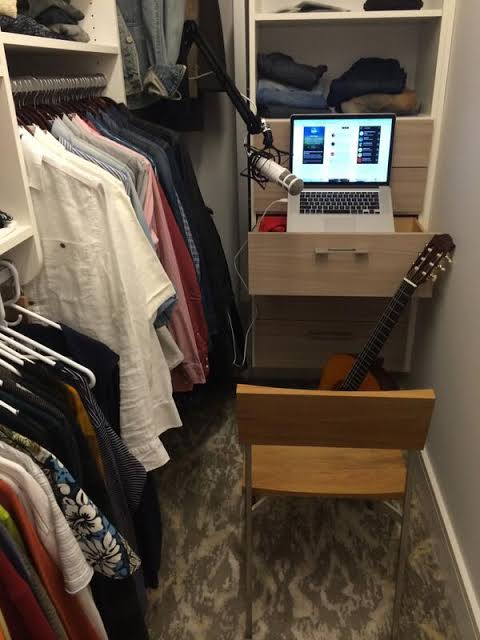
Then there's the 19% of you dealing with the ultimate nightmare: realizing the vocals were recorded on a phone in a closet. We love accessible production, but no amount of compression can completely erase the vibe of a voice memo recorded next to a pile of winter coats.
Struggling to mix your vocals? Check out our guides to polish your tracks:
- Ultimate guide: how to EQ vocals for beginners
- Clean up your vocals: a step-by-step guide to a polished sound
- What is de-essing? The dos and don’ts of using a de-esser
September 14, 2026: What is your most trusted source for verifying a mix?
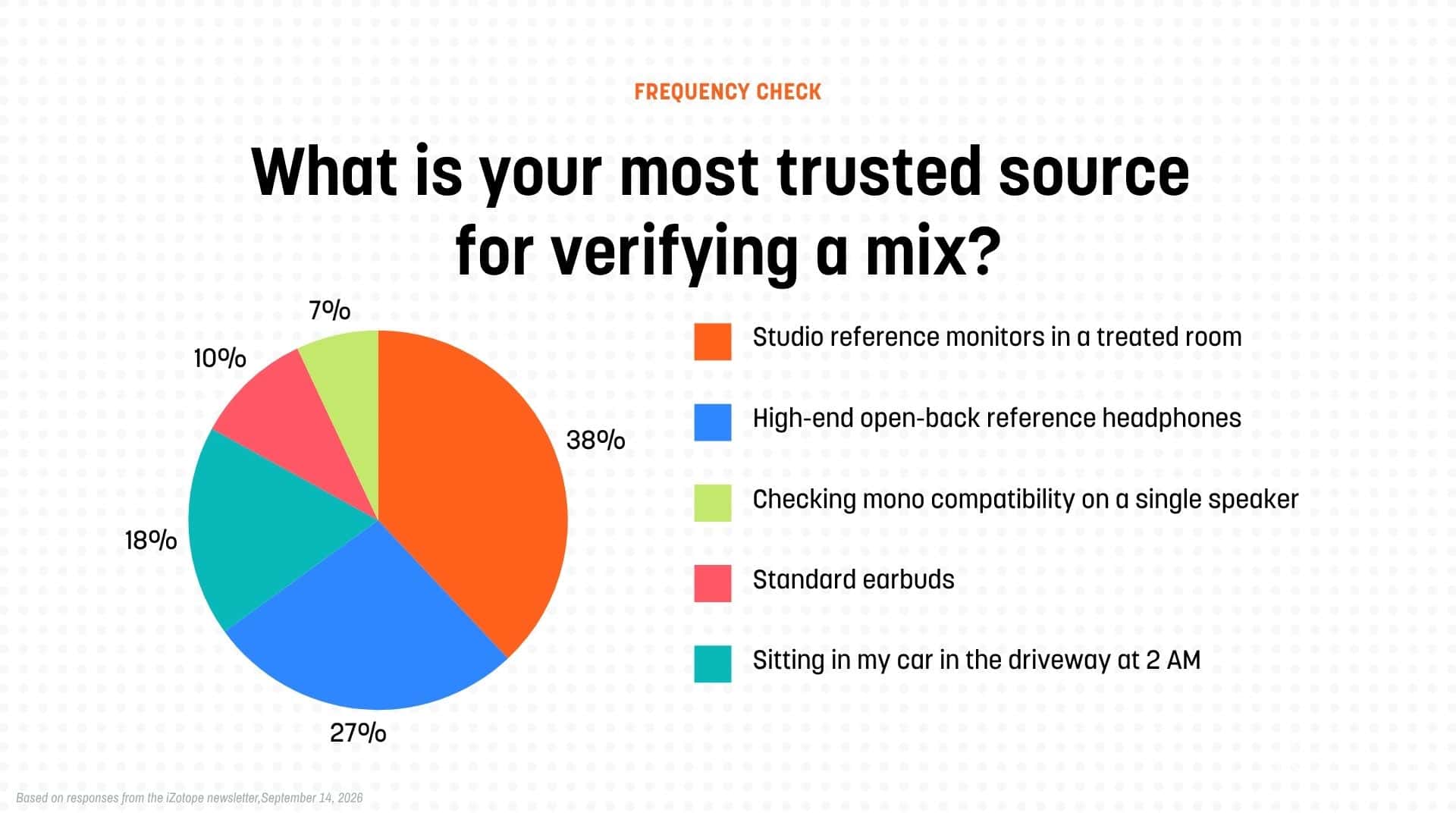
Unsurprisingly, 38% of you do things by the book with reference monitors in a treated room, while another 27% lean on high-end open-back headphones. That’s nearly two-thirds of our community – and we respect the discipline.
Then there’s the rest of us.18% admitted that their ultimate truth comes from sitting in their car in the driveway at 2 AM (because if the bass slaps there, it slaps everywhere). Everyday earbuds took 10%, and dedicated mono speaker checks brought up the rear at 7%.
Hey, treat your room all you want, but the driveway never lies.

September 8, 2026: What technology has made the biggest impact on your audio production?
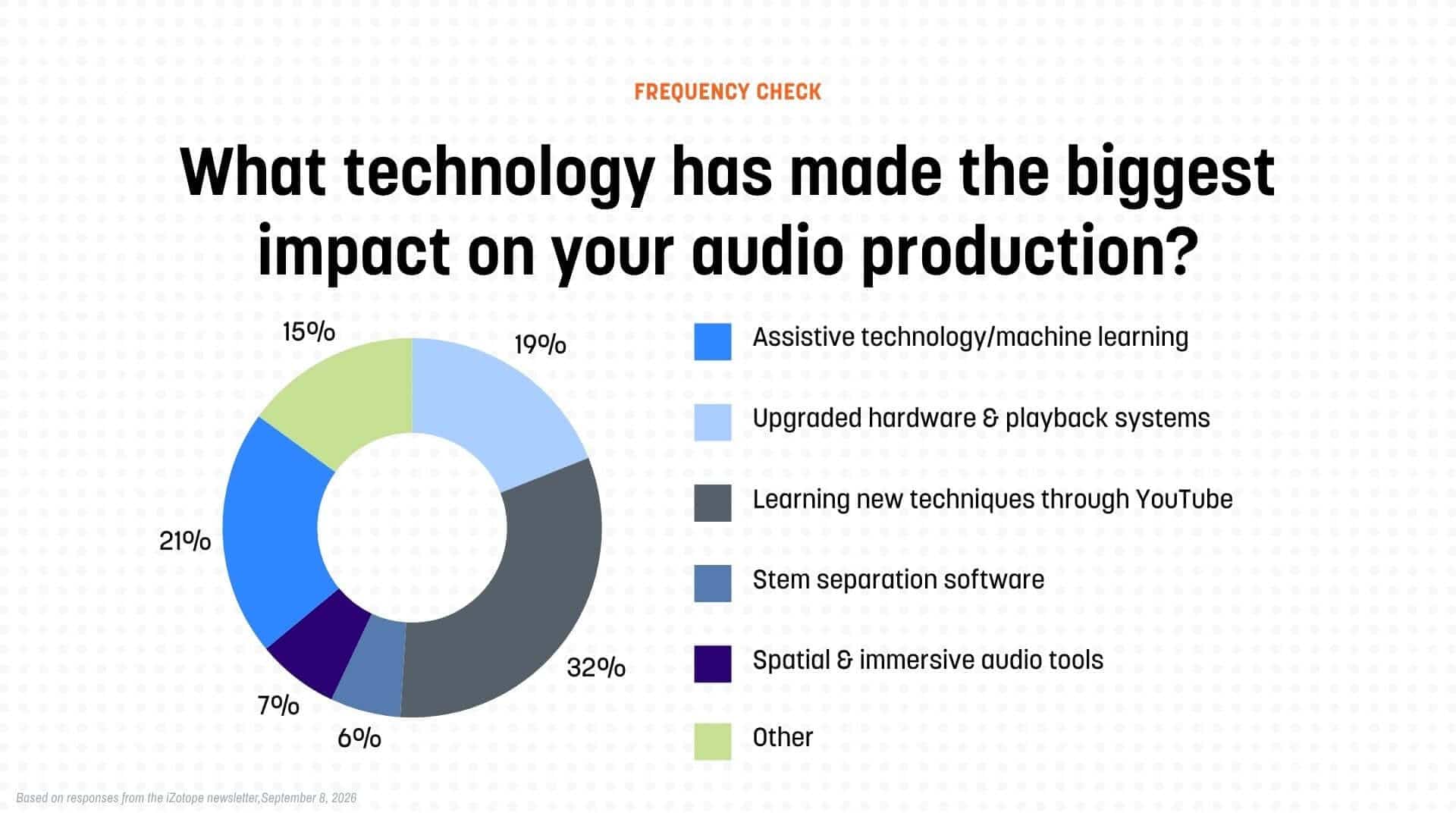
Learning new techniques through YouTube took the top spot with 32% of the vote, proving once again that accessible online education continues to reshape modern audio production. In fact, we asked top audio educators a similar question this past week – and several agree that YouTube has been the most transformative technology for audio production.
Smart tools and physical gear followed closely behind: assistive technology and machine learning captured 21% of responses, while upgraded hardware and playback systems earned 19%. Together, Youtube learning and AI-assisted workflows accounted for over half of all responses, highlighting how heavily creators rely on intelligent tools to accelerate their process.
Niche technology and custom write-ins rounded out the rest of the field. Spatial and immersive audio tools took 7%, while stem separation software gathered 6%.
Finally, 15% of respondents wrote in their own game-changers – citing everything from core DAW features and room correction to classic reminders like taking care of your ears – and even "harnessing electricity."
Looking for guides on some of these areas of technology? Take a look below!
September 1, 2026: What sound hurts your soul the most?
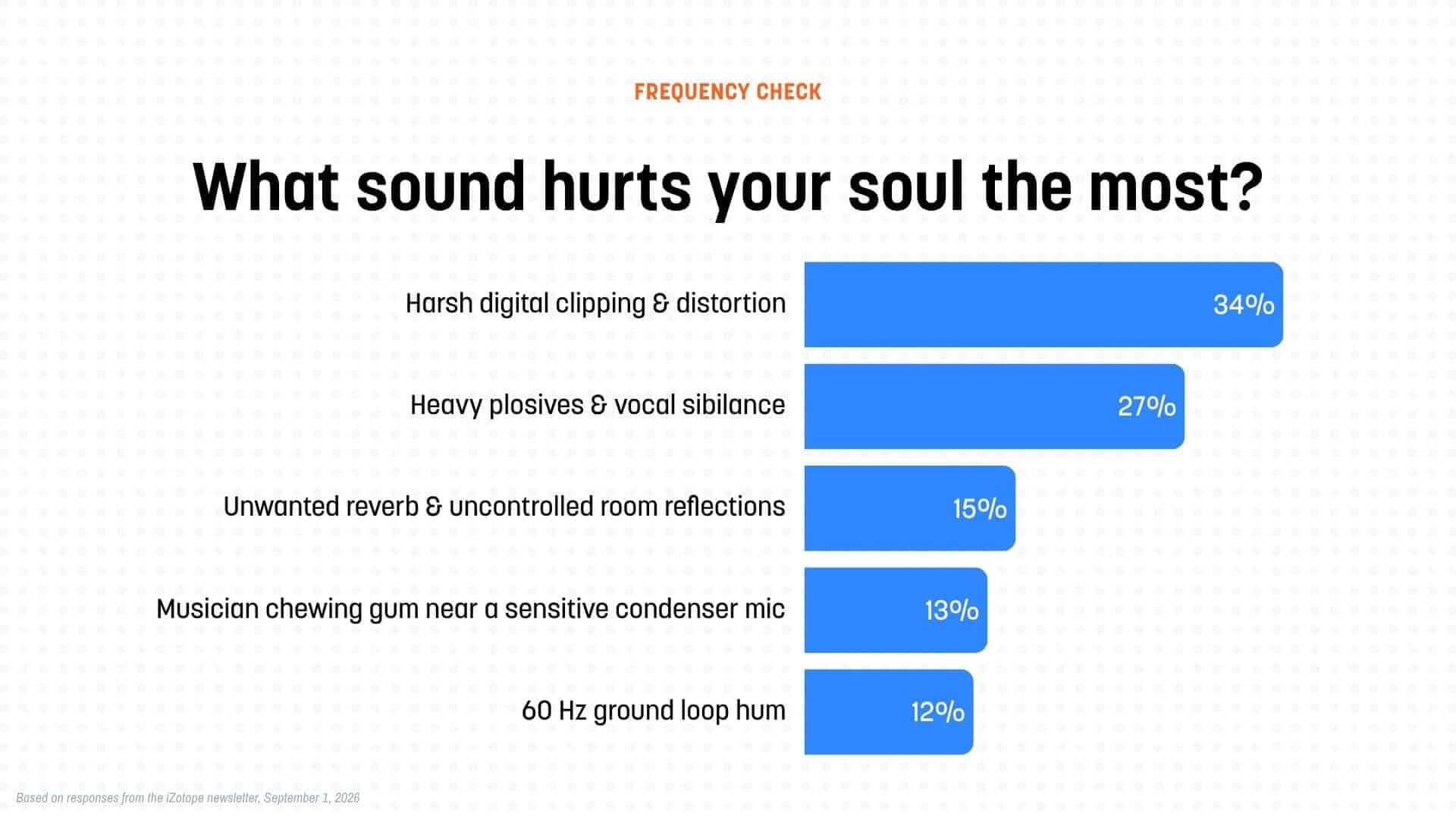
Harsh digital clipping and distortion claimed 34% of all votes, standing out as the single biggest offender. Heavy plosives and harsh vocal sibilance followed closely behind at 27% – meaning dynamic artifacts and harsh frequencies account for over 60% of what hurts producers' ears most.
The remaining votes were split among studio environment issues and physical nuisances: uncontrolled room reflections took 15%, a musician chewing gum near a sensitive condenser captured 13%, and 60 Hz ground loop hum brought up the rear with 12%.
Looking to clean up your audio? Check out our video on how music producers use RX to save their mixes:
August 25, 2026: How are you saving the mix today?
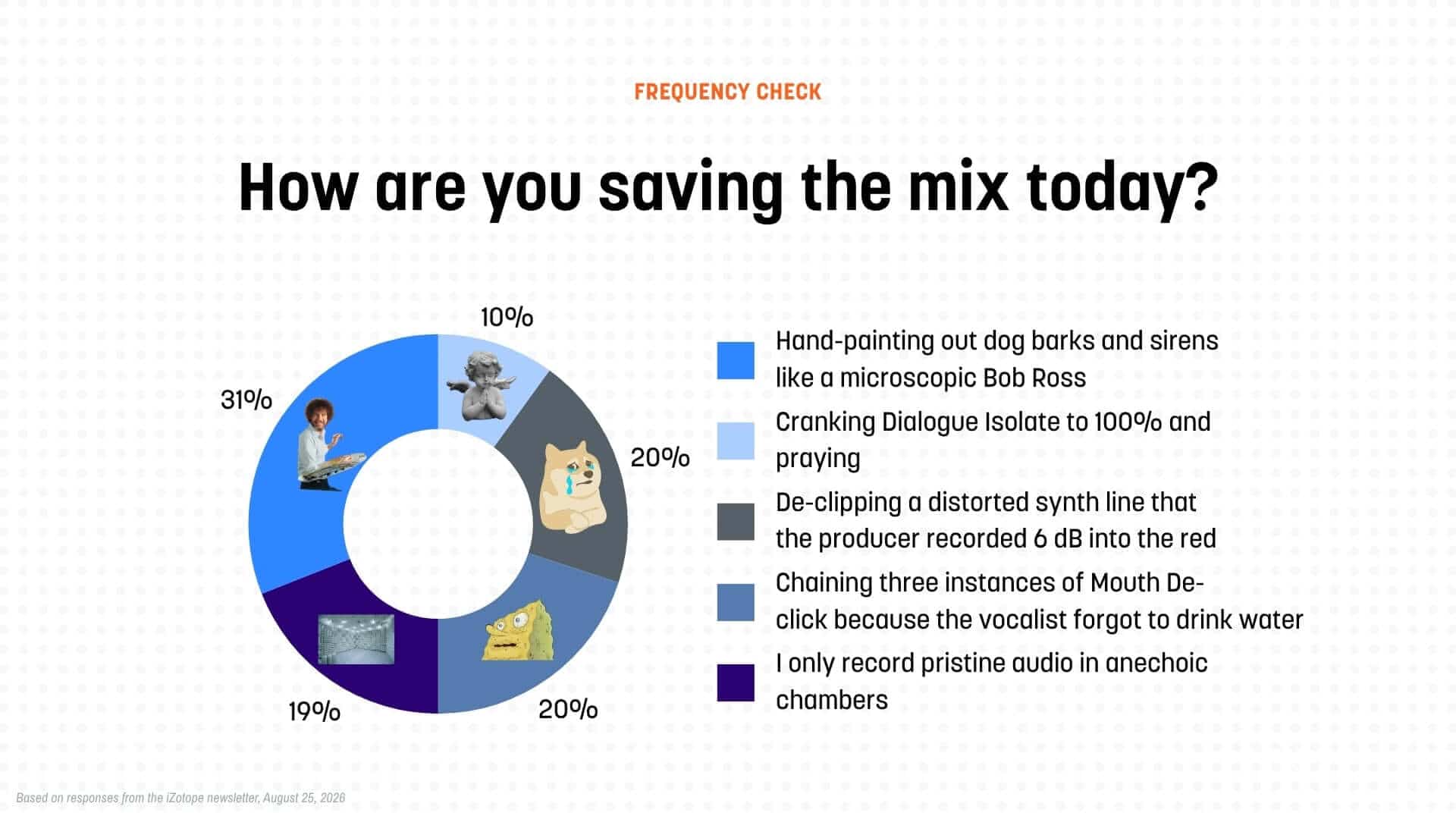
Audio repair is a rite of passage for audio engineers. The results are in, and over 30% of you manually paint out background noise, while another 40% battle mouth clicks and digital clipping. Respect to the 19% recording in silent rooms – the rest of us will stick to RX and hope for the best!
Looking for more tips on audio repair and restoration? Fix recording issues with our guides:
Clean up your vocals: a step-by-step guide to a polished sound
How to fix guitar audio issues: amp noise, fret squeaks, and string plucks
August 18, 2026: How’d you learn to make music?
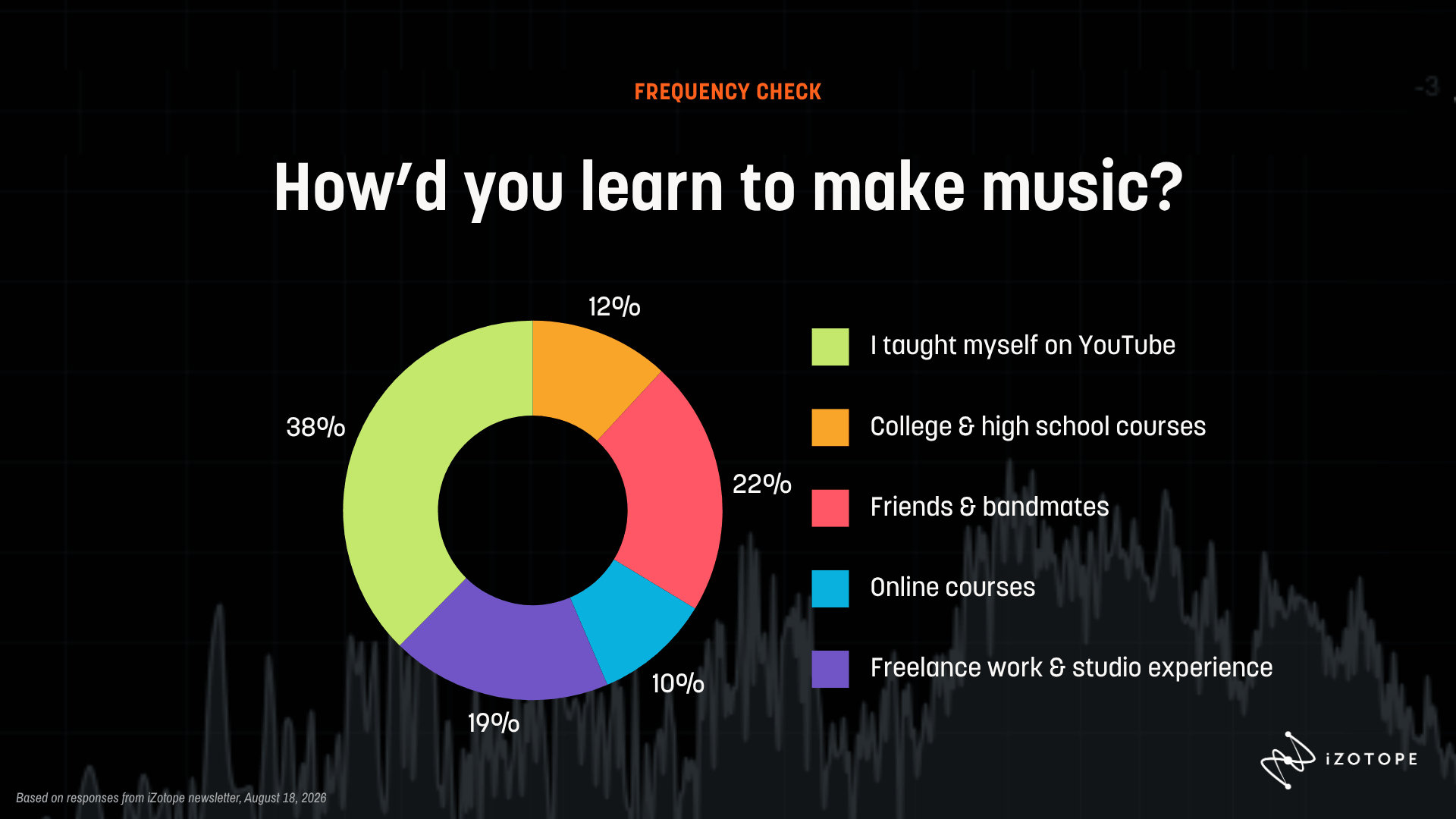
The results are in: 38% of you learned how to produce music primarily through YouTube. Are you surprised, or was that completely expected? Paired with the 22% who learned from friends and bandmates, a full 60% of our community developed their ears in informal, peer-driven environments. It turns out late-night video deep dives and collab sessions are some of the biggest classrooms for audio engineers in training.
Real-world experience is not something to sleep on either, as 19% gained their chops through freelance work and studio experience. Formal education held its ground, with 12% coming from high school or college courses and 10% taking online courses.
If YouTube is your go-to production school, check out the iZotope YouTube channel’s guides on mixing, mastering, audio repair, and more.
August 11, 2026: What’s the most challenging for you?
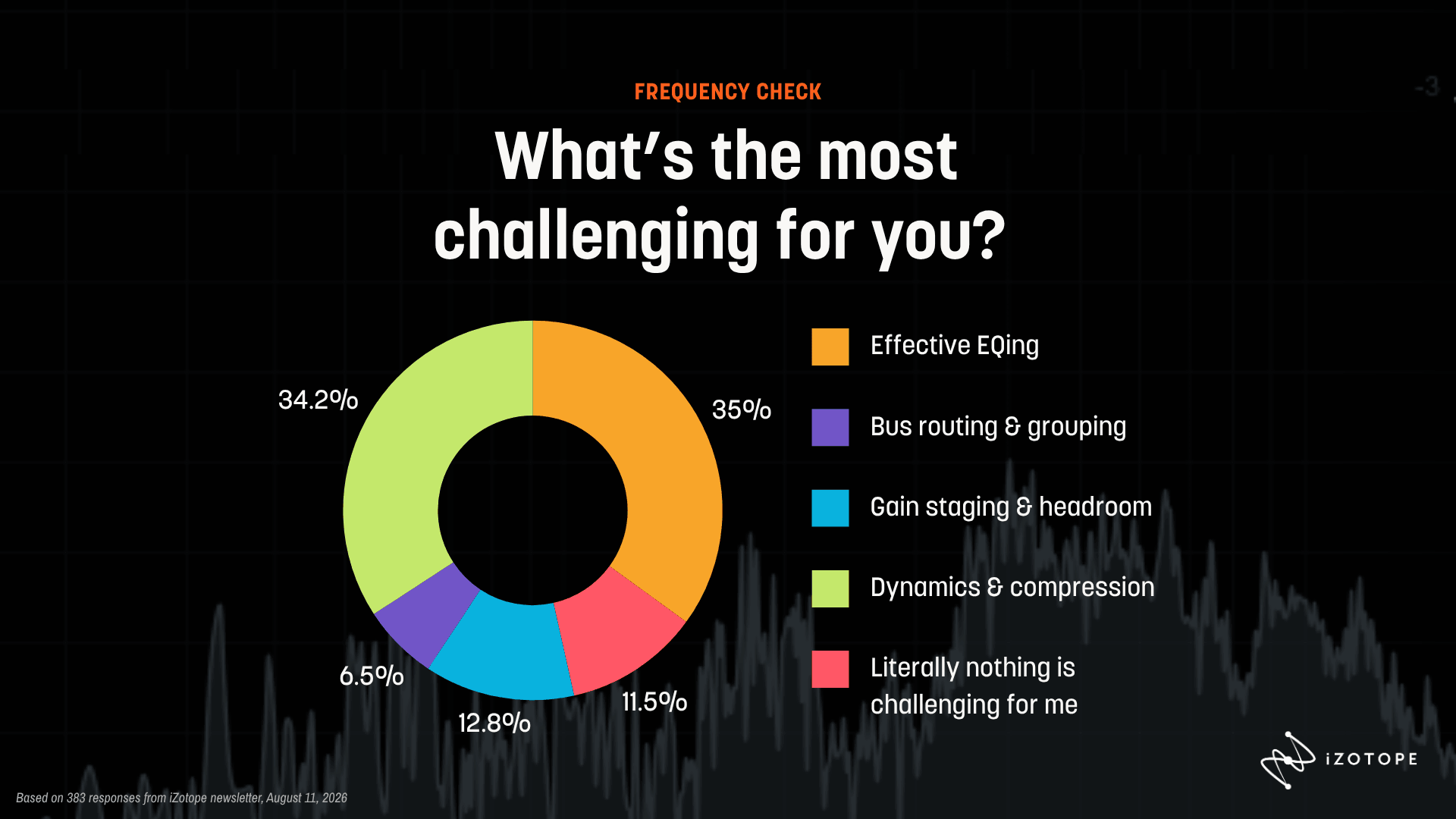
Unsurprisingly, EQing (35%) and Dynamics (34.2%) finished neck-and-neck, capturing nearly 70% of total responses. Finding space for every instrument while controlling peaks AND without squashing the life out of a mix is tough! When you're managing complex frequency overlaps and subtle compression thresholds, it's easy to second-guess whether you're effectively mixing the track or over-processing it.
If you’re looking to improve your EQing and dynamics processing, check out our guides below:
Gain staging and headroom (12.8%) and bus routing and grouping (6.5%) took up the rest of the technical struggle. Gain staging and routing might not feel as creative as tone shaping or controlling transients, but keeping clean headroom and an organized session layout often prevent mix bus distortion and workflow fatigue before you even touch an EQ or limiter.
…And we admire the absolute confidence of the nearly 12% of people who said nothing is challenging.
Where do you fall on the spectrum?
Ready to share your workflow habits and see how you stack up against the rest of the audio production community? Subscribe to the iZotope newsletter below to catch every new Frequency Check poll in your inbox each week. Your thoughts will help shape our next breakdown!