Table of Contents
The year 2000. I remember spending hours documenting analog console and outboard gear settings at the end of a mix session. Even longer for a 48-track mix with two tape machines.
If a client called a week later wanting a vocal up half a decibel, there was a good chance the mix would need to be rebuilt from recall notes, photographs, and memory. Decisions mattered because changing anything was difficult and expensive. It wasn’t traumatic at the time, because we were making the best use of the tools available to us.
Fast forward twenty-five years – and I am completely spoiled. Today I can open a laptop, instantly recall a session, run hundreds of tracks, and use tools that can identify masking frequencies, repair damaged audio, and even audition mastering chains. What once required a room full of equipment can now happen almost anywhere, with a decent set of headphones... and maybe virtual control room emulation software.
The technology has changed dramatically. The art has not.
Whether I’m working on a record, a broadcast, a game soundtrack, or an immersive mix, the same questions remain. Will the listener get the story being told? Can they feel the emotion in the performances? Does every element support the vision for the mix?
Since 2000, mixing has evolved from analog consoles and tape machines to intelligent software ecosystems powered by tools like iZotope RX, Neutron, and Ozone. Workflows are faster, revisions can effectively be unlimited, and deliverables are more voluminous and complex than ever.
But great mixes still come from the same place they always have – careful listening, good judgment, and the experience to know what matters most to the outcome.
This is the story of how mixing has changed over the last twenty-five years, and what has remained surprisingly, sometimes annoyingly, constant.
25 years at a glance
Here’s the short version, side by side. The sections that follow tell the story behind each column.
| Analog, c. 2000 | Hybrid, 2000s | In the box, 2026 | |
|---|---|---|---|
| The rig | Large-format console (Neve, SSL, API, MCI, Trident), analog multitrack tape, hardware EQs, tube/FET/VCA compressors, physical and rack-mounted reverbs and delays, and a lot of manual patching | A DAW running alongside the analog console, hardware processing still doing much of the heavy lifting, early plug-ins, and digital automation | Virtually unlimited tracks, AI-assisted and intelligent mixing/mastering tools, spectral editing, source separation, advanced metering, Dolby Atmos, and cloud collaboration |
| The sound | Saturation, harmonic distortion, noise, and nonlinear behavior – technically imperfect, but often adding depth and unique timbres | Often called cold or sterile; brick-wall filters and 16-bit/44.1 kHz left little margin for error, and digital clipping was unforgiving | Extraordinary transparency and fidelity; the analog-vs-digital debate has given way to what simply sounds great |
| Working around the limits | Commit early: compress and EQ while tracking (adding extra top end to survive tape loss), print effects, keep fewer takes, submix to save tracks | Put the analog character back: tube mics and preamps, tape emulation, analog summing, saturation plug-ins, vintage hardware inserts | Fix it later: timing, pitch, noise, phase, acoustic distractions, arrangement problems, home recordings – and mislabeled files |
| Setup and recall | Hours to set up, hours to recall: settings documented by hand, outboard reset, sessions partly or fully rebuilt | Full session recall becomes practical; setup shifts to organizing files and checking plug-ins and routing | Instant. Open the session and the mix is exactly where you left it |
| Revisions | Kept to a minimum. Recalls were time-consuming and expensive, so clients were encouraged to decide and move on | Easy recall invites more revisions; engineers stop offering unlimited remixes | Effectively unlimited – so knowing when to stop becomes the hard part |
| Deliverables | Stereo masters on ¼" or ½" tape with test tones, digital 2-track, DAT, CD production masters, instrumentals, vocal up/down 1.5 dB; timecoded stereo mixes for broadcast | All of that, plus radio edits, TV tracks, alternate versions, and digital distribution masters | Stereo and Atmos masters, stems, instrumentals, alternate versions, archive sessions, and social media formats |
| Who signs off | The artist and the producer | Artists, producers, labels, managers, marketing teams, distribution partners – and influencers | |
| What set great engineers apart | Access: to studios, equipment, and knowledge | Taste, musical judgment, critical listening, communication, efficiency, and decision-making | |
2000: The room was the instrument
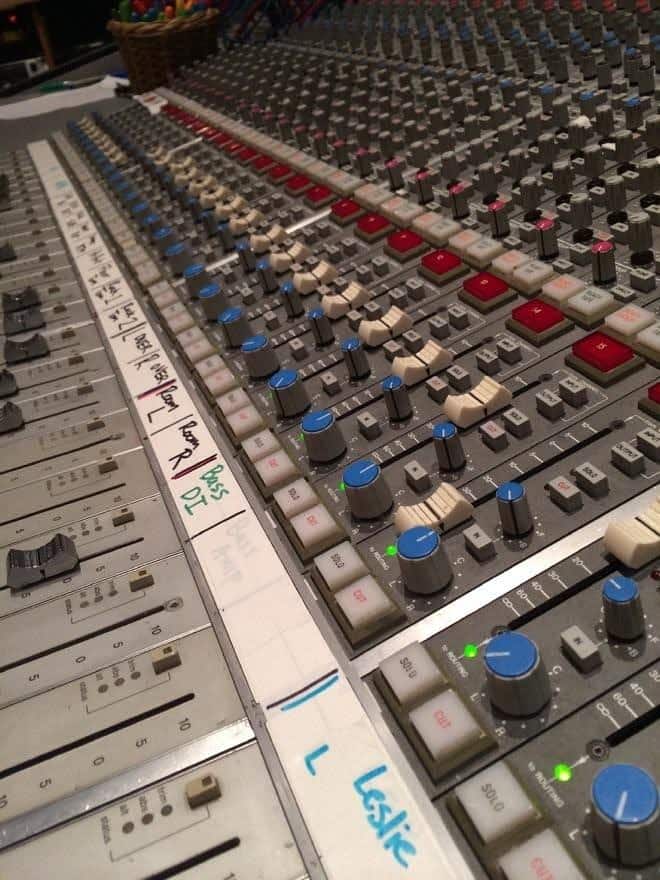
In its purest form, professional mixing at the turn of the century revolved around a large-format analog console, a multitrack tape machine (or two), and a wall of outboard gear. The studio itself was a creative instrument. Access to a great room, great monitors, and great outboard gear could be as important to the sound as the engineer operating it, and top engineers used proprietary signal chains to create their magic. Brand names like Neve, SSL, API, MCI, Trident, and a host of others were keys to sonic success.
Because tape was expensive and tracks were limited, many decisions happened early. We compressed and EQ’d during tracking – often adding extra high end, knowing the tape would lose some of it between tracking and mixing. We printed effects, submixed to conserve tracks, and committed to performances. Nobody was keeping all 27 takes of the guitar solo.
Workflow was often regulated by tape loading and rewind time, giving the creative team time to consider what they had just recorded. Recording and mixing were closely linked, as there was little or no opportunity to revisit decisions later.
Setting up a mix could take hours, and recalling a mix could take just as long. Console settings were documented and recalled manually in many cases, outboard processors had to be reset, and revisions often required rebuilding part or all of the session. This led me to start using stereo stem submixes early on, so revisions could be handled efficiently without recreating the entire mix. As ace mixer Eric Schilling recalls, “This is often why we did not recall for nitpicky stuff. It was time consuming and expensive.” Clients were encouraged to make decisions and move forward.
Drummer: “Snare drum up 6 dB!”
Guitar player: “Turn the snare drum down 6 dB.”
Singer: “Mute the snare drum in the verses.”
It got to the point where I’d take bids on level changes – and you could be outbid by another band member. Having the band there actually helped, though, because during a live analog mix you could give each of them a fader group to ride. We also kept a “special” fader for when a label rep was in the house. It was usually labeled “SPARKLE” or “Pizzazz,” and it was connected to… nothing. OK, I’m half-kidding, but you get the point. Most of the time, we mixed on our own or with an assistant and burned mixes to CD-R for review.
In that era, most engineers learned to mix through an apprenticeship or internship. I learned from some amazing mixers just by watching how they worked. There were audio schools, of course, but the more common path was landing a gig as a runner at a pro studio and assisting on sessions once the coffee was delivered. If you were lucky, you’d get some time on the board to practice mixing a safety copy of an outtake. One of my mentors, producer/engineer Greg Riker (Faith Band, Spooner, Roadmaster), kindly gave me a reel of edited outtakes to practice with while he was on vacay in the Caribbean, or some such place. To me, that reel was pure gold.
The 2000s: The hybrid years
As DAW technologies matured, hybrid workflows became common. Studios combined DAWs with analog consoles, hardware processing, early plug-ins, and digital automation. Many engineers still relied on hardware, but digital workflows increasingly handled editing and session management. By this point, Pro Tools was gaining acceptance as a production tool, and we were printing mixes to DAT, ¾-inch 1610, and analog tape.
I always kept a Mac laptop on hand for support: email, data management, burning CD-Rs, and so on. We were all learning about “digital hygiene” at that point, meaning file naming conventions, folder hierarchies, and backups. There were no archival standards or best-practice guidelines yet, so we made it up as we went along. My first 9 GB hard drive cost almost $4,000 and filled up fast, so backing up data to CD-R became routine.
Around that time, Mix magazine ran a story on the recording of a Madonna album. The cover photo showed a control room with an old-school beige CRT monitor, and someone had written “SAVE – SAVE – SAVE” in Sharpie all the way around the screen. What do you think inspired that graffiti?
My guess: early DAWs crashed a lot, and someone didn’t save and lost hours of editing. Today’s DAWs run on a laptop, auto-save, and have the power to put 10 plug-ins on every track of a 100+ track session if I want to (I usually don’t). My Power Mac G4, by contrast, could handle maybe 10 plug-ins across the whole session before crashing. Did I mention they crashed a lot?
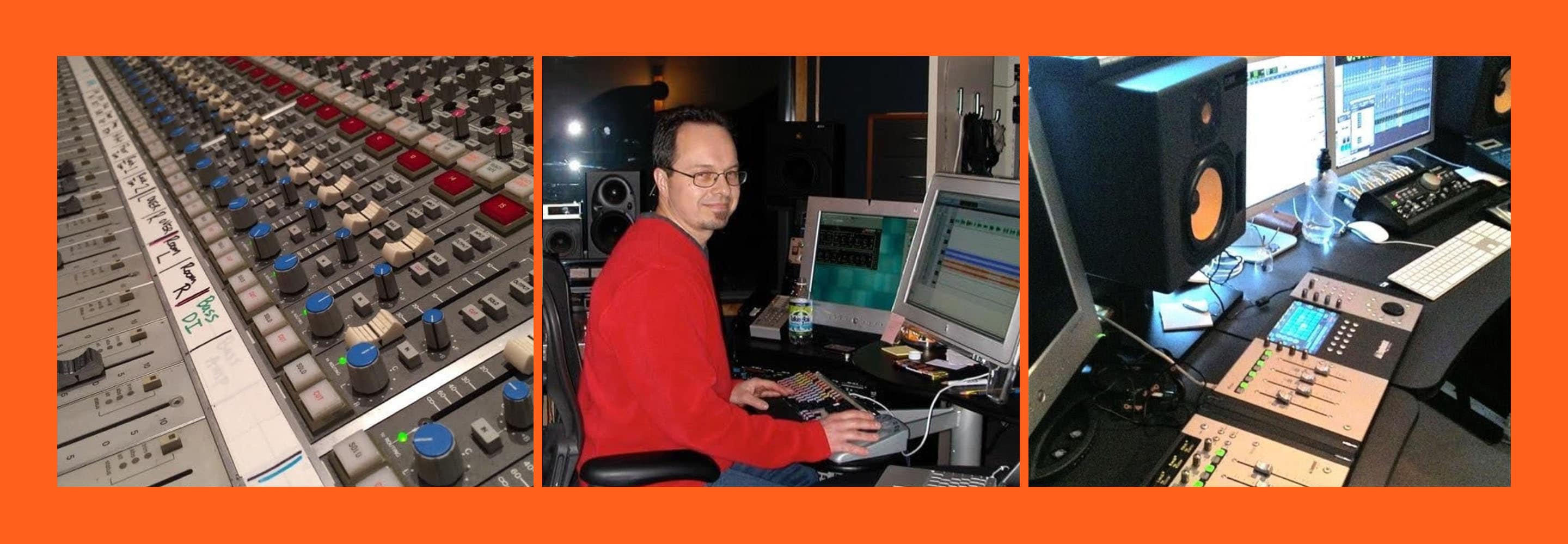
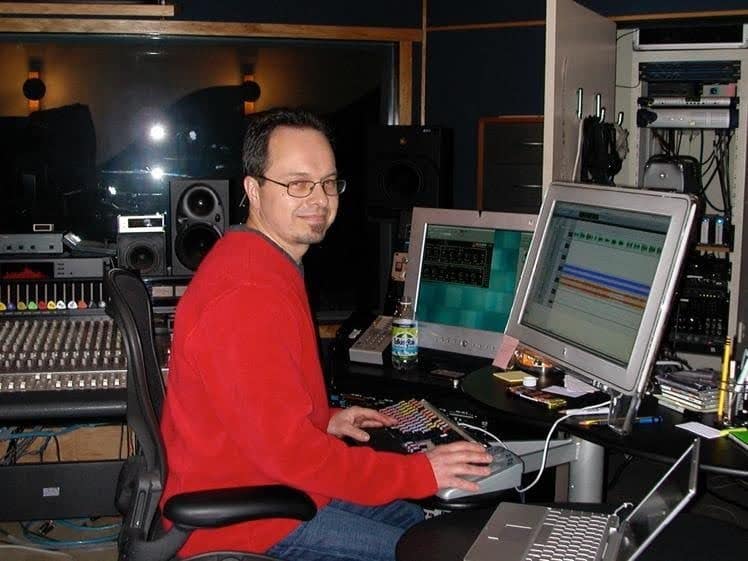 Glenn at a DAW workstation in a control room, with an analog mixer beside him
Early digital recordings were frequently described as cold or sterile compared to tape. Sometimes the criticism was valid. Early converters and plug-ins had limitations. Red Book standard audio resolution (16-bit/44.1 kHz sample rate) left little margin for error, and we learned that digital clipping would most definitely NOT enhance our recordings. Again, Eric Schilling: “A lot of what contributed to the harsh sound of early digital recordings was due to the brick wall filters. As oversampling and other technologies improved, so did the sound of digital.” Sometimes it was simply the absence of the analog coloration engineers had become accustomed to hearing.
So a generation of products emerged to put that character back – tape emulation, analog summing, and saturation plug-ins – while tube microphones, preamps, and vintage hardware inserts earned a second life as tone generators. Ironically, engineers spent years recreating the artifacts they had previously worked hard to minimize.
For the first time, complete session recall became practical. Mix setup shifted from rebuilding hardware signal chains to organizing files and verifying plug-ins and routing. But as revisions became easier, clients began requesting more of them, and the time saved with instant recall was often spent editing, re-editing, and re-re-editing countless versions of singles and albums. That changed the way engineers billed for their time, too: no more unlimited remixes.
The mix engineer was becoming both a creative professional and a file manager. Eminent engineer/producer Mike Clink adds that he has even been tasked with editing and changing the arrangement of a song after the mix was completed.
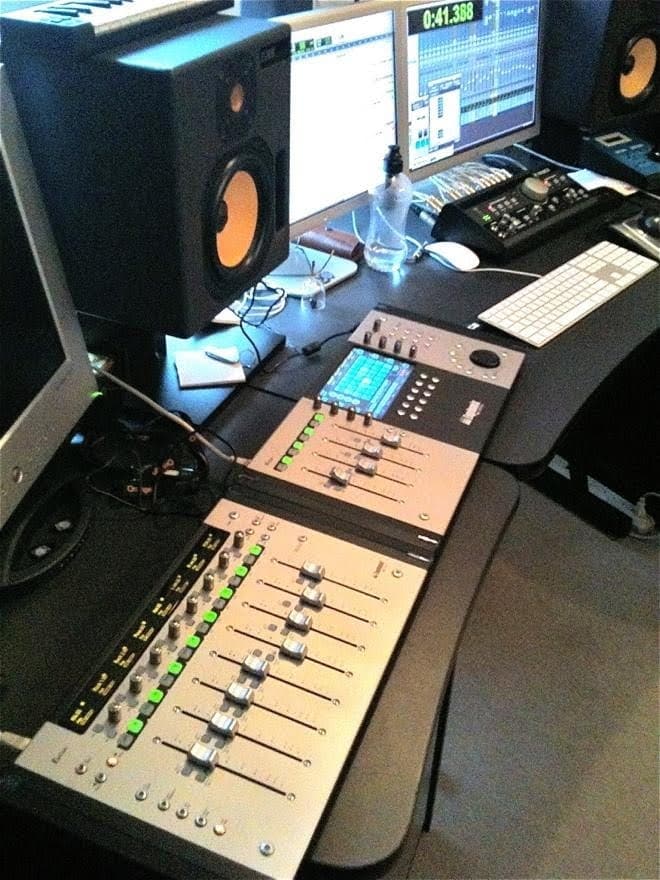 An in-the-box desk with a DAW control surface, studio monitors, and a session on screen in 2010
2026: A studio in a backpack
A world-class mix studio kit can now fit inside a backpack, and Schilling says track counts have exploded, regularly exceeding 400 tracks per song. We download sessions and tracks from the cloud, deliver mixes to online servers, and rarely see our clients in person. I can edit and comp tracks on a plane or at the beach, and clients can sit in on mix sessions over Zoom. I do miss the camaraderie of a big multi-room facility full of creative people, but I can now get more done in an hour than I could in an entire day in 2000.
Modern digital systems have achieved extraordinary transparency and fidelity. The old analog-versus-digital debate has largely been replaced by a more practical reality: listeners respond to great music and great mixes, regardless of whether they were created with hardware, software, or a combination of both. And with the resurgence of vinyl and cassette, listeners are discovering that there are alternatives to streaming.
One of the biggest advances is that software no longer simply emulates hardware. Many processors now do things that never existed in the analog world.
Spectral processing. Traditional EQ works on fixed frequency bands, typically four to six per device. Modern spectral processing can act dynamically on individual events within a frequency range. A harsh vocal resonance can be reduced only when it occurs; a problematic cymbal overtone can be controlled without dulling the entire source. What once required detailed automation now happens dynamically, with far greater accuracy and repeatability.
Neutron and Ozone in practice
The most profound shift in modern mixing is that processors are becoming context-aware rather than simply reacting to level or frequency.
Take a dense rock mix, where vocals and guitars often fight in the 2–4 kHz range. Twenty-five years ago, a mixer might permanently cut those frequencies in the guitars to make room for the vocal – which dulls the guitars, forces them to be turned up, and can throw off the whole balance. Not ideal. Today, Neutron’s Masking Meter and Dynamic EQ can identify the overlap and reduce those frequencies only when the vocal is present. Instead of making compromises, the software creates space only when necessary.
| The challenge | Then | Now | The payoff |
|---|---|---|---|
| Vocal vs. guitars (2–4 kHz) | Permanent EQ cuts in the guitars | Neutron Masking Meter and Dynamic EQ duck the guitars only when the vocal is present | Better vocal clarity, fuller guitar tone, less aggressive EQ |
| Kick vs. bass guitar/synth | Static subtractive EQ carving permanent holes in the bass | Neutron dynamic processing momentarily reduces conflicting lows only when the kick hits | Low end that stays powerful, controlled, and natural |
| Getting started on 150+ tracks | Hours of administrative balancing across drum mics, synth layers, and stacked vocals | Neutron Mix Assistant establishes a starting balance in minutes | More time for creative decisions – the mixer still makes the final ones |
| Will the mix translate? | Burn a reference CD, listen in the car, adjust, repeat | iZotope Tonal Balance Control gives objective feedback before the mix leaves the studio | Catches what a lying room hides or exaggerates |
| Building a mastering chain | Manually configuring filtering, EQ, levels, compression, multiband, limiting, and metering | Ozone Master Assistant analyzes the mix and generates an intelligent starting point in seconds | Efficiency, not autopilot – the engineer owns the result |
| Delivering for streaming | Maximize loudness and win the loudness war | Ozone evaluates integrated loudness, true peak levels, dynamic range, and codec performance | Consistency across playback platforms |
Every mix room lies. Mostly. Some exaggerate low frequencies; others hide them. Like all of these tools, the value isn’t automation – it’s getting to the real decisions faster, with better information.
The modern mix engineer
Perhaps the biggest cultural shift is the expectation that almost anything can be fixed later. As the line attributed to Frank Zappa goes, “We’ll fix it in the shrink wrap.” Mix engineers now routinely address timing and pitch problems, noise, phase relationships, acoustic distractions, arrangement issues, inferior home recordings – and, inevitably, unnamed or mislabeled files. The mix engineer has become equal parts artist, technician, problem solver, and quality-control specialist.
Bob Olhsson, the great Motown engineer, has noted that you can take a substandard recording and make it sound OK, but not great. You have to capture it the best you can at the source. That is not common practice in 2026.
Twenty-five years ago, much of an engineer’s expertise was tied to access: to studios, equipment, and knowledge. Today, world-class tools are available to nearly everyone, and the differentiators have become taste, musical judgment, critical listening, communication, efficiency, and decision-making. Technology has democratized capability. It has not democratized experience.
Ironically, many experienced mixers use less processing than they did twenty years ago. With better recordings, better instruments, and more intelligent tools, the challenge is often exercising restraint. The question has shifted from “What can I do?” to “What should I leave alone?” You may have 450 plug-ins, but do you need to use them all on every track?
Meanwhile, the line between mixing and mastering has blurred. Streaming platforms, immersive formats, and sophisticated analysis tools have pulled many mastering considerations into the mix stage itself, and clients want rough mixes “normalized” so they sound more like finished masters. With stereo masters, Atmos masters, stems, alternates, archives, and social media cuts all on the list, modern engineers spend as much time managing assets as they do creating them.
Approval workflows have also changed dramatically. In the past, approval involved the artist and producer. Today, feedback may come from artists, producers, labels, managers, marketing teams, distribution partners, and influencers (I’m not even kidding).
Technology has made collaboration easier while increasing the number of stakeholders involved in the process. Clients can attend “virtual” sessions and give instant feedback, but most prefer to listen on their own time and text or email their revision notes. The upside is a paper trail proving they really did sign off on that mix, or really did ask for the vocal up 0.25 dB. I recently mixed an immersive EP for a well-known artist who insisted that no vocals should ever be tuned. I sent off a round of mixes, and the next day I got an email asking why I hadn’t tuned the obviously flat note in the bridge. Sorry, my bad!
Start mixing music with a modern mindset
Has mixing changed since 2000? The easy answer is yes.
Are today’s engineers spoiled? I say heck yes (speaking purely for myself). Eric Schilling says, “Yes and no. Unlimited tools can make it harder in some ways. Mixing needs to be a combination of gut reaction and cerebral reaction to a mix. Don’t overthink it.”
The deeper answer is that mixing has changed in almost every way except the one that matters most.
In 2000, a mix engineer’s day might involve recalling a console, aligning tape machines, patching outboard gear, and documenting settings by hand. Today, that same engineer might be mixing in Atmos, using Neutron to solve masking issues, RX to repair recordings, and Ozone to evaluate how a master will translate across streaming platforms.
The technical limitations that shaped generations of engineers have largely disappeared. Processing power is abundant. Recall is instantaneous. Storage is effectively unlimited. Intelligent software can identify problems, suggest solutions, and automate tasks that once consumed hours of studio time.
Yet technology hasn’t made mixing easier. It has simply created different challenges.
When every tool is available, judgment becomes more valuable than gear. When revisions are unlimited, decision-making becomes more important than flexibility. When software can suggest solutions, experience determines which options have merit and deserve to be followed.
That may be the most important lesson from the last twenty-five years. Great mixers were never defined by their consoles, tape machines, plug-ins, or software suites. They were defined by their ability to hear what the music needed and make deliberate choices in service of it.
A great mix in 2000 required that skill. A great mix in 2026 requires exactly the same skills.
The tools have changed. The workflows have changed. The expectations have changed. But the mission remains timeless: create a mix that induces an emotional reaction when the listener hits play.