
Table of Contents
For Denver-based DJ and producer Discognition, finishing records became a question of speed, trust, and context. With his recent remix of Eli & Fur’s Air landing on NYX Music, the need to evaluate tracks quickly and decisively mattered more than chasing ideal conditions or extended revision cycles.
Ozone became part of that process early on. Instead of exporting mixes and waiting on external feedback, Discognition used Ozone to hear how his ideas translated as finished records while the session was still open. That immediacy allowed him to test arrangements, low-end balance, and overall impact the same day a track came together.
That approach aligned closely with how he works. With multiple projects moving at once, Discognition relied on Ozone to bring consistency and control without interrupting writing or arrangement decisions. It gave him a clear reference point between a working mix and something ready to share with labels, play in sets, or test outside the studio.
The Air remix reflects that workflow just as much as Ozone supported that habit by keeping the technical side of mastering accessible and repeatable, which continues to shape how he releases music and presents it in real-world settings.
Discognition’s success story starts here, so let’s get into it! Plus, download some of Discognition’s personal Ozone presets for free.
Interview with Discognition
What made you start using Ozone to master your own demos?
Honestly, I started using Ozone out of practicality.
When you’re producing constantly, you’ve got a ton of works-in-progress and demo ideas that you want to test, whether that’s sending them to labels, playing them out in a set, or just getting feedback from your peers. It doesn’t make sense to fully master every track at that stage, but I still wanted them to sound cohesive and punchy enough to represent the idea properly. That’s where I turn to Ozone.

It gives me the ability to get a “release-ready” loudness and tonal balance without spending hours tweaking or hiring a mastering engineer for something that might just be a draft.
What I love about Ozone is how visual and intuitive it is. The tonal balance control, dynamic EQ, and stereo imaging give you instant feedback on what your mix might be missing. You can see right away if your low end’s too heavy or if your mids are masking a vocal. And honestly, the presets are a great starting point.
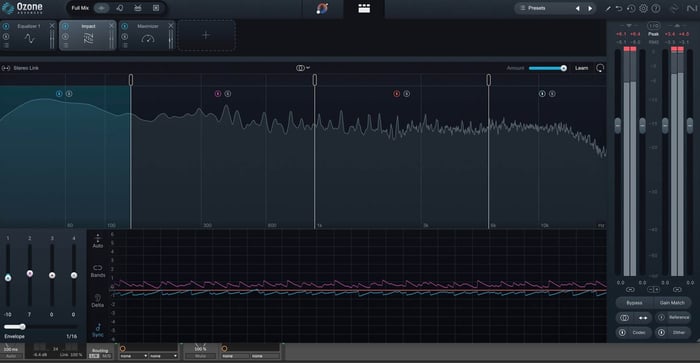 Discognition using Ozone in his session
They’re not meant to be perfect out of the box, but they get you in the right ballpark. I’ll usually start with something like the “Modern Warmth” or “CD Master – Balanced” preset, listen to how it shapes the track, then fine-tune from there. Once you understand how the modules interact – like the Exciter into the Maximizer, or how different limiter characters affect transients – you can really tailor it to your sound.
For demos, I’m not chasing the final polish that a dedicated mastering engineer brings; I’m just aiming for something that feels finished enough to translate on different systems. Ozone helps me bridge that gap between raw mix and release-ready energy. I can trust that what I’m sending out will sound clean, dynamic, and cohesive without overthinking it. I think another important highlight here is that Ozone saves me money in the long run too.
A lot of labels will have their own in-house mastering engineers, so I don’t need to pay for my own master (depending on the label contract), just to have the label ask me to send the mixdown so they can master it on their end.
Pro tip from Discognition: When comparing your mastered version to your original mix or references, make sure they’re level-matched. Louder will always sound better at first, but matching levels helps you hear real improvements – clarity, width, and tone – instead of being tricked by volume.
How long does it usually take you to get a song to a place where you feel confident sending it out?
It really depends on the track, but generally, I like to live with an idea for a bit before I feel confident enough to send it out. Some songs click right away, maybe I nail the groove and the atmosphere in a day or two and those are easy to polish up for a demo. But other times, I’ll loop back over the course of a few weeks, refining transitions, dialing in the arrangement, or adjusting sounds that don’t quite sit right.
I’ve learned not to rush that process because giving it space usually leads to better creative decisions. I used to rush through the process because I was excited about an idea, but learned over time that it was a detriment. I like to let it simmer at this point.

Once the core idea feels solid and the mix is translating well across my monitors, headphones, and coveted car test that we all know and love, I’ll start treating it like a finished track, just without obsessing over the details. That’s usually when I’ll throw it through Ozone for a light master so it feels cohesive and loud enough to share. That step really helps me hear it in a more “real-world” context, the way a label or listener would.
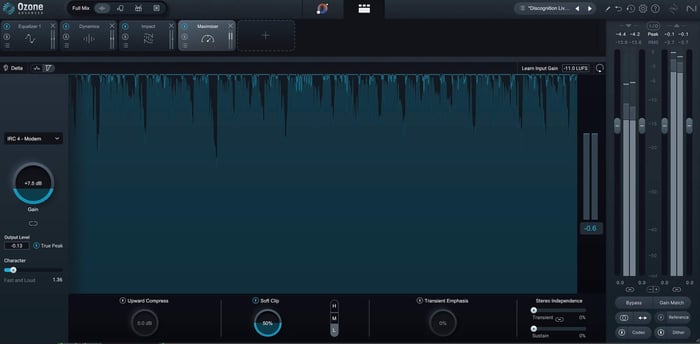 Discognition using Ozone Maximizer
Overall, I’d say anywhere from a few days to a couple of weeks is typical. I try not to overthink it. If a track gives me the right emotion and energy, that’s usually my cue it’s ready to send out.
I’d rather get feedback early than sit on something forever trying to make it perfect.
Pro tip from Discognition: Ozone’s Maximizer is powerful, but it’s easy to overdo it. Get your mix sitting right first, then bring the limiter in gently. Aim for a master that’s competitive, not crushed – especially for demos. Labels and DJs care more about vibe and dynamics than a wall of sound.
How do you keep perspective when mastering your own demos? Do you use references or trust your gut?
That’s a great question — and honestly, it’s a bit of both. When you’re working on your own music, it’s really easy to lose perspective because you’ve heard the track a hundred times in different forms. So even though I trust my instincts a lot, I always bring in reference tracks when I’m mastering demos. I’ll usually grab a few songs that capture the vibe or energy I’m aiming for — same BPM range, similar tonal balance — and A/B them against my mix. It’s not about copying them, but more about making sure my track holds up sonically when played next to something that’s already been released.
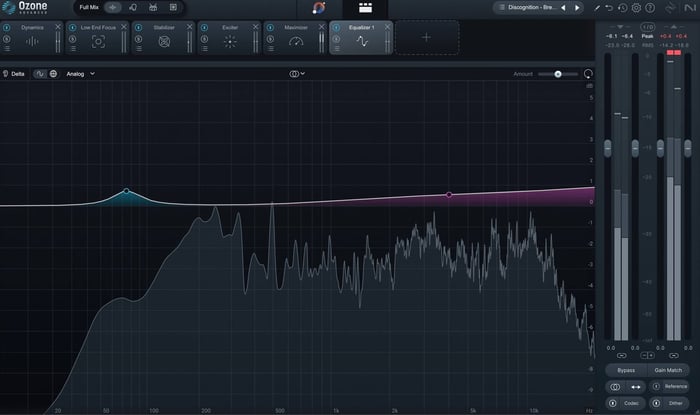 Ozone EQ module
That said, I’ve learned to trust my gut over time. When I first started, I’d overanalyze every frequency and second-guess myself constantly. Now, I know what feels right in the context of a club system or headphones. If the groove feels locked in, the low end’s tight, and I can play it next to my other tracks without it feeling dull or flat, that’s my green light.
I also make sure to take breaks – like, literally step away for a few hours or listen the next morning with fresh ears. That distance is everything. It helps me reset my perspective and catch things I might’ve missed the night before. So yeah, references are super helpful, but at the end of the day, your ear and your instincts are what tie it all together.
Pro tip from Discognition: It’s one of the most underrated tools in the suite. Dropping your mix against a tonal balance target for your genre gives you instant feedback on where your low end or highs might be off. It’s not about chasing perfection, but it helps you course-correct when your ears get tired.
Has self-mastering helped you feel more confident putting your work out without gatekeepers?
Absolutely. That’s one of the biggest reasons I started self-mastering in the first place.
Early on, I used to get stuck waiting for approval – from labels, from engineers, from whoever I thought had the “final say” in whether a track was good enough. Learning to do a clean, presentable master on my own gave me the freedom to move faster and trust my own taste. If I feel something’s ready, I can bounce it, test it out, and share it that same day. That kind of creative autonomy is huge.

It also changed the way I think about perfection. When you handle that final step yourself – even just for demos – you realize it doesn’t have to be flawless to be effective. Some of my best feedback has come from sending out tracks that weren’t fully dialed in yet, but captured a feeling. Being able to polish a demo enough that it feels “release-ready” without overthinking it keeps the momentum going and helps me stay in love with the process.
So yeah, it’s empowering. Having the tools and knowledge to self-master means I’m not waiting on anyone to validate my sound. I can get my ideas out into the world faster, connect with people, and keep evolving without getting stuck behind that gatekeeping mindset.
Pro tip from Discognition: Always make sure your mix isn’t clipping before Ozone – a few dB of headroom gives the limiter room to breathe. And above all, use your ears over your eyes. The visuals are great, but if it feels good and translates across systems, that’s the real win.
What’s your advice for someone who struggles to hear the difference between a good mix and a working master?
That’s a really common challenge – and honestly, it just takes time and repetition.
The main thing to understand is that a good mix already sounds balanced and full before mastering. The mix is where you get your kick and bass to play nicely, your vocals to sit right, and your overall dynamics to feel natural. A working master, on the other hand, is really just about enhancing what’s already there – bringing up the overall loudness, tightening the tonal balance, and making sure the song translates across different playback systems. If your mix doesn’t already sound great, no amount of mastering will fix it.
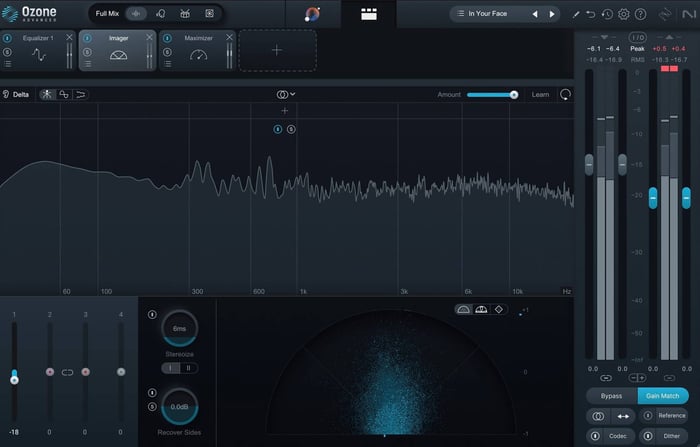 Ozone Imager module
One thing that really helps is level-matching. When you compare your mix and your mastered version, turn down the master so they’re roughly the same volume. Louder almost always sounds better to the ear, so leveling them out helps you actually hear the real differences – clarity, punch, width, and tonal balance – instead of just being tricked by volume.
And most importantly, train your ears with reference tracks. Load a few well-mixed, well-mastered songs in the same genre into your DAW and switch between them and your own track. Listen for how the low end feels, how bright the highs are, how the midrange sits.
Over time, you’ll start to recognize those subtle differences naturally. It’s not something that clicks overnight, but once it does, you’ll know exactly when your track’s ready to leave the “good mix” stage and step into that “working master” zone.
Pro tip from Discognition: Ozone’s presets can be super inspiring – they’ll get you in the right tonal ballpark. But don’t just slap one on and call it a day. Flip through a few that match your genre, listen critically to how they change your mix, and then tweak the modules to fit your sound. Think of them like templates, not magic buttons.
Finally, how has using Ozone for demo mastering changed your relationship with your own unfinished music?
Honestly, it’s made me way more comfortable living with unfinished ideas.
Before I started using Ozone, I used to have this habit of shelving tracks because they didn’t sound big or finished enough to share. They might’ve had a solid groove or a cool idea, but without that final polish, I couldn’t hear their full potential. Once I started running my demos through Ozone, though, everything changed – suddenly I could hear what the song could be. It gave my works-in-progress a sense of life and energy that made them exciting again.
It also made the creative process less precious. When you can quickly make something sound cohesive and loud enough to play out or send around, you stop overthinking perfection and start focusing on momentum. I can bounce an idea, throw on a gentle mastering chain in Ozone, and test it the same night – in the car, on headphones, or even in a set. That immediacy keeps the inspiration flowing.
In a weird way, it’s helped me build a stronger relationship with my own music. Instead of viewing “unfinished” tracks as failures, I see them as snapshots – ideas that are alive, evolving, and worth sharing. Ozone just helps bridge that gap between the raw and the refined, so I can stay connected to the creative spark without getting bogged down in the technical grind too early.
Pro tip from Discognition: It’s tempting to use every module Ozone offers, but less is usually more. My typical demo chain might just be an EQ → Imager → Exciter → Maximizer. You don’t need to “fix” what isn’t broken. Subtle, intentional moves always win over complexity.
Wrapping it all up
Self-mastering became a practical extension of Discognition’s release process rather than a final technical hurdle. With Ozone in his setup, he handled that last stage with clarity and intention, making decisions quickly while the creative direction of a track was still clear. That control supported the steady output that led to his recent Air remix and the broader attention surrounding it.
Ozone allowed him to move from idea to release without delay, keeping projects active and responsive to real-world testing. Tracks could be played in sets, shared with collaborators, or refined further without breaking momentum. That consistency continues to shape how Discognition releases music, builds visibility, and stays connected to the work he puts into each record.