
Table of Contents
Aruna Abrams has spent the last decade shaping the sound of modern vocal-driven electronic music, but her newest project required a different kind of focus. Working on a piano ballad bound for Eurovision, she stepped into the producer’s chair to capture raw performance under intense constraints: limited studio time, wide vocal range, and the emotional scale of a televised competition. The result is a body of work that merges technical control with vulnerability.
Produced for Houston-based artist KARIANA, the project was created for Melodi Grand Prix, the Norwegian selection competition for Eurovision 2026. While the track didn’t end up winning the contest, the sessions reflect a new chapter for ARUNA as a producer rather than a featured vocalist. Her approach relied on iZotope Nectar 4, not as an effect to hide behind, but as a decision-accelerator, enabling fast, intuitive work while preserving a sense of truth in the performance.
What makes this session unique is how human it remained despite the technology around it. Working quickly, ARUNA balanced analytical precision with emotional instinct, treating each pass not as a take to fix but as a conversation to capture.
The following interview explores how she used Nectar to translate feeling into form, shaping a song designed to resonate across both stage and screen.
Interview with ARUNA
When you’re producing vocals with Eurovision in mind, what’s the first thing you focus on?
For something like Eurovision, my primary focus is the performance – capturing the emotion of the lyric, getting the singer to really feel what she’s saying, and making sure she’s singing from a raw, vulnerable place that’s going to stir something inside the listener.
This particular song is a piano ballad, and it’s very rangey. So we need all the technical elements to be in place in terms of pitch, timing and tone – but for me, the emotion is what makes it penetrate. If I’m not feeling it, odds are the listener won’t be either.
How did Nectar help you shape the vocal so it felt polished but still natural?
The vocalist on this project lives in Houston. She was only in LA for a short time, so working fast was critical. There was a song that we had been referencing from the beginning in terms of the writing and the production, and I really loved the vocal on it as well.
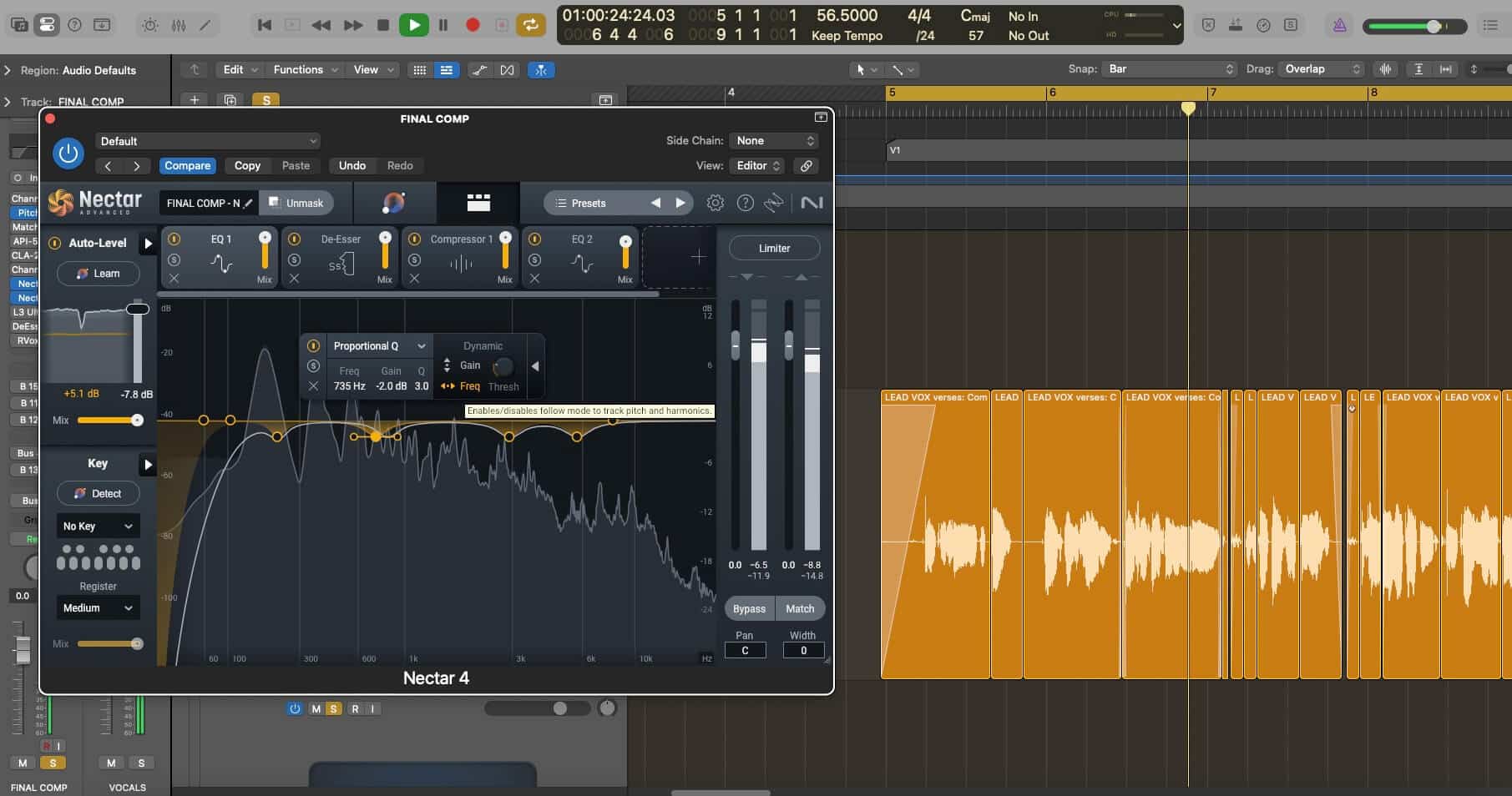 Using Nectar in ARUNA's session
Being able to use that vocal as a target in Nectar‘s Vocal Assistant saved a lot of time that would have been spent laboring over EQ and compression settings. It allows you to load up an a cappella, which it then analyzes and applies characteristics of to the vocal in your project. In this case, I was missing some of the warmth, presence and body from that reference track. It was great to be able to quickly and easily dial that in using Nectar.
Another feature that really helped was the Auto Leveler.
A lot of times when I have a vocal where some words are too soft and others are too loud, I’ll go in and manually chop the audio up and change the gain setting in each region. Obviously this is extremely time-consuming and with her only being here for a short time, we didn’t have that luxury, so this feature came in really handy. It looks at the incoming audio and adjusts its loudness in real time to match a dB target that you set before it hits any of the other processors in Nectar.
Once you send it into other processors, in Nectar or even further down your plugin chain, they don’t have to work as hard to even things out, so you end up with a really nice, natural sound.
Did you reference other Eurovision ballads when making choices in Nectar or did you trust your instincts?
We made a playlist that we used as a reference for the writing and the production. Some of the songs there were Eurovision ballads. Others were just songs that we really liked that had that epic, emotional quality to them that we were looking for.
At the end of the day, though, I will always trust my instincts, because they’re ultimately all I have. They’re what guide every decision I make, which is what makes my sound unique.
 ARUNA
ARUNAI hadn’t done anything quite like this before, particularly as a producer – so it was useful to have some guidelines to lean on. I watched a lot of Eurovision performances to get a sense of the scale of the whole thing and what kinds of arrangements would work best in that arena. The ballads all had this very dramatic and theatrical quality to them, so I wanted to be sure to capture that in all aspects of the track, including the vocals.
What did you set up in Nectar to make sure you were capturing usable takes right away?
The setup for live recording was pretty bare bones in terms of plugins. I engaged the low latency mode, which disables almost everything while she is actually singing. Once we listen back to the various takes, it’s important to me as producer that she likes what she’s hearing. If she doesn’t, it can really rattle her confidence. As a singer myself, I know that can negatively affect future takes.
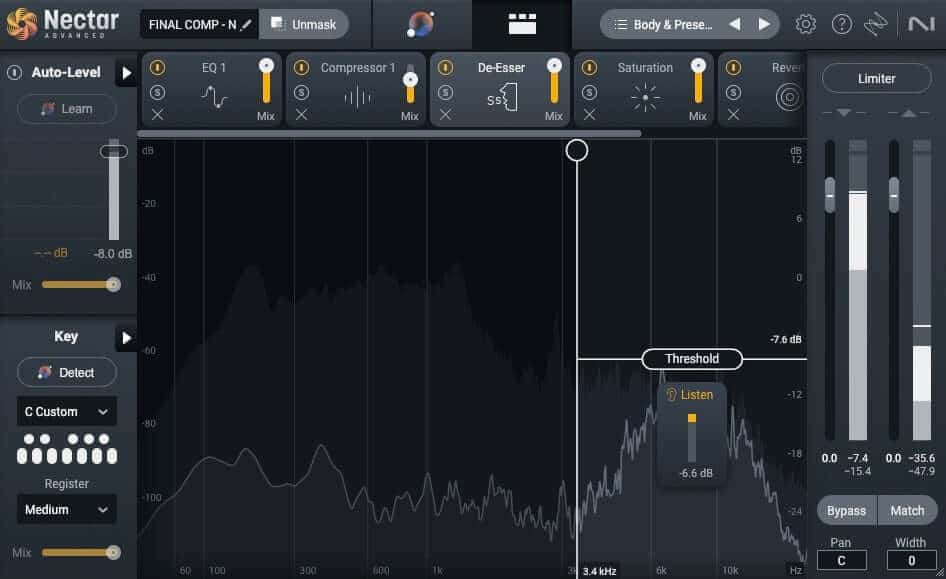 Nectar De-esser module on the vocal
I opened a second instantiation of Nectar and clicked on Detailed View. From there you can access a preset menu which has a ton of various configurations of all of Nectar’s different modules.
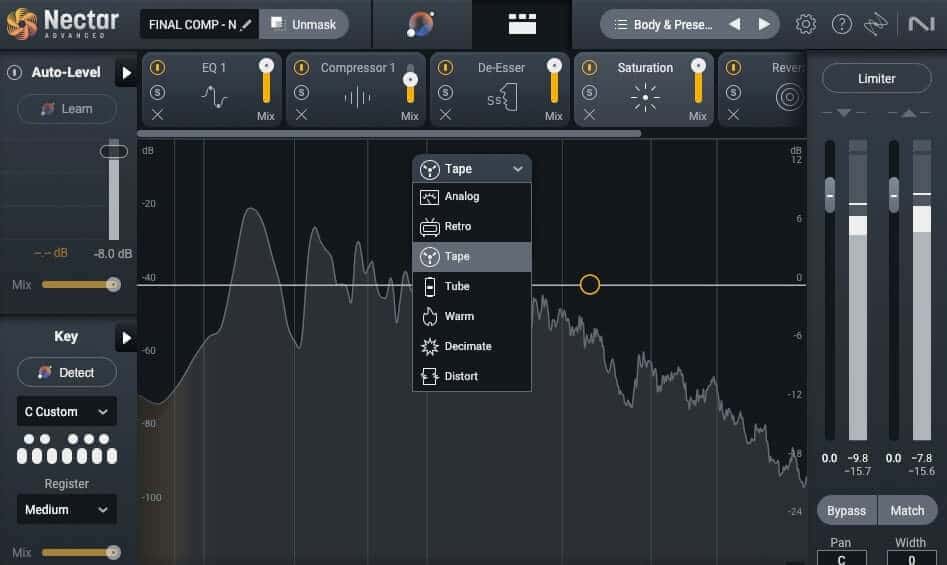 Exploring different types of saturation in Nectar
I noticed one called Body & Presence and it instantly delivered what I was looking for – some elements that were similar to what I’d created using the Vocal Assistant but with the addition of some nice high end sheen, tape saturation, and a touch of reverb – all with one click.
Has working on a piano ballad shifted your perspective on arrangement or vocal space compared to more electronic material?
I actually started as a singer/songwriter doing more pop and acoustic material long before I got into trance, so that perspective was already in place. Once I migrated to electronic music I ended up bringing it with me, so much so that when guys would send me tracks, I would figure out what the chords were and then sit down at my piano to write the topline. I liked being able to start and stop as needed during the writing process, and I think it made my toplines sound more organic – basically like pop songs – than a lot of others in that genre.
Now that I’m producing and I’ve been moving away from dance music back towards pop, it’s kind of brought everything full circle. I feel like at this point, I need to be able to produce what I write. A lot of the time when I’m writing, I’m holding a vision for the entire sound of the song in my head. It would be difficult for me to have to hand it off to someone else and try to communicate what I’m hearing. I did that in the past, of course, before I was able to produce, but it’s so much more satisfying being able to bring the entire vision to life as you intended.
What advice would you give to producers who want to get into vocal-heavy productions but come from a club or instrumental background?
I think the most important thing is listening to a TON of music with vocals, paying attention to what works and what doesn’t and trying to figure out why. Start making reference folders of songs you like that you can see yourself moving in the direction of. Those will be your North Star in the beginning. Watch lots of tutorials on working with vocals, how to get them to sit well in your mix.
Also it’s probably best to start with acappellas that get sent to you already recorded. That way, all you have to deal with is getting them to sound good from a technical point of view. Working with a singer live in the studio is a fairly new experience for me and it’s a completely different animal than working with an acappella.
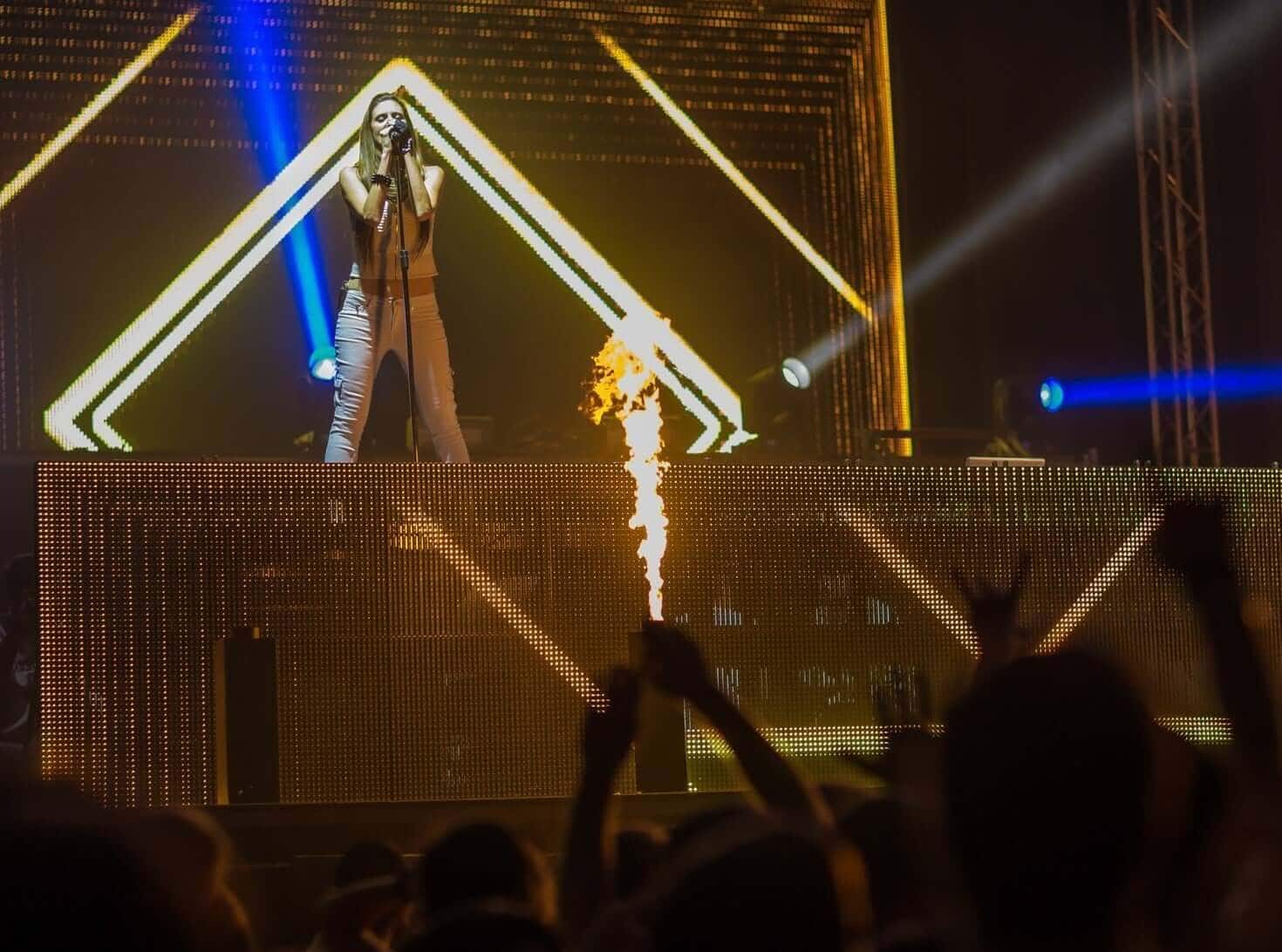 ARUNA live
You’re dealing with a lot of human psychology, being sensitive to that vulnerable place they’re in when they’re recording but still being able to communicate any issues you have in a way that won’t upset them or frustrate them or make them lose confidence in themselves. Knowing the mechanics of singing helps me communicate with them in their language. And little tricks I’ve used cutting my own vocals in the past, with things like how to punch in seamlessly or tracking line by line in a problematic section can help as well. Like with anything, the more you do it the better you’ll get.
And having go-to tools, like Nectar, that you know well and can rely on will help you actualize what you’re hearing in your head with minimal fuss.
Wrapping it all up
ARUNA’s Eurovision work marks a moment of convergence: her past as a vocalist, her present as a producer, and her long-standing belief that technology should serve emotion, not replace it. In the studio, Nectar became more than a plugin. It was a translator between intention and result, helping her move from inspiration to delivery with precision and warmth.
As she continues developing new projects, this process will likely remain her blueprint: capture truth first, refine later. The balance of artistry and technical fluency defines not only the song at hand but also the producer behind it.